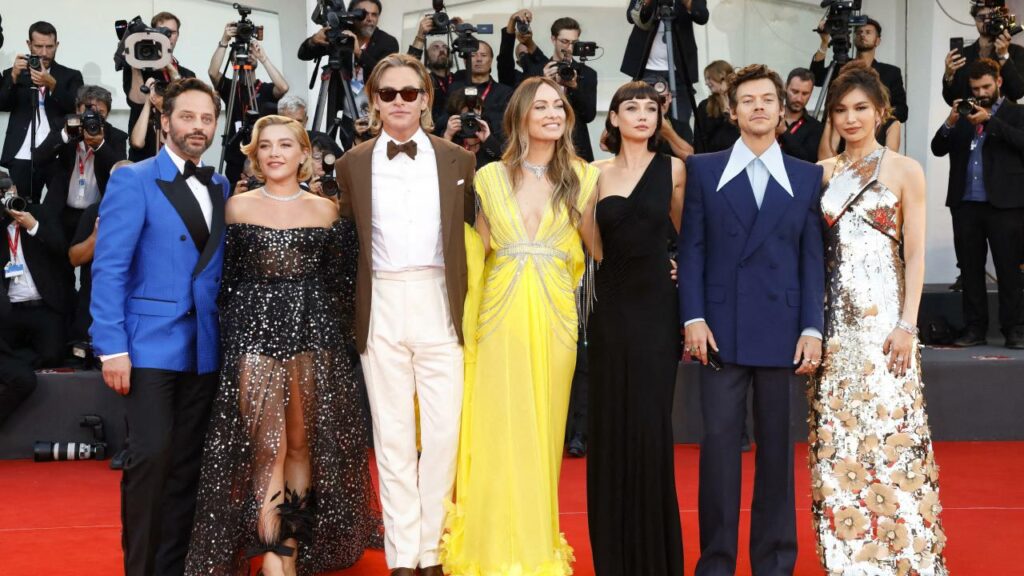
Don’t Worry Darling Ending Explained. Don’t Worry Darling or Don’t Worry Honey in Quebec is a 2022 psychological thriller movie directed by Olivia Wilde. The screenplay is written by Katie Silberman, with Carey and Shane Van Dyke. Harry Styles and Florence Pugh star in the lead roles, with Olivia Wilde, Chris Pine, KiKi Layne and Gemma Chan in supporting roles. It was introduced at the 2022 Venice Film Festival.
Don’t Worry Darling Summary
Alice and Jack Chambers are a happy 1950s couple living in the idyllic working-class town of Victory, California, which was started and funded by the mysterious namesake company that Jack works for. Every day, the men go to work at Victory’s headquarters, which is in the desert environment, while their wives – Alice, her friend Bunny, pregnant Peg, newcomer Violet and Margaret – stay home to clean, rest and prepare dinner for their husbands.
They are not encouraged to ask about their husband’s work or venture into headquarters because of the “hazardous materials” used there. Margaret became an outcast among the other wives after taking her son into the desert, which led to his apparent demise. She claims that Victory punished her by taking her son away from her, but all the locals think it is paranoia caused by her trauma. At a party thrown by Frank, the enigmatic founder and leader of Victory, Alice sees Margaret’s husband trying to give her medication. Later, while Alice and Jack are secretly having sex in Frank’s room, Alice realizes that Frank is watching them but says nothing.
One morning, while driving around town in a trolleybus, Alice notices a red biplane crashing in the desert. Alice sets off into the desert to track down the crash and arrives at Victory Headquarters, a small building covered in reflective windows. When she touches one of the windows, she experiences surreal hallucinations before waking up that very same night at her home while Jack is cooking dinner.
Over the next few days, Alice begins to experience several strange occurrences: she feels like she is being crushed by the walls of her home and has once found an egg carton containing only empty shells. She receives a phone call from Margaret, who says she had the same visions as her. Later, during a dance lesson given by Shelley, Frank’s wife, Alice has a vision of Margaret banging her head against a mirror. She rushes to her neighborhood just in time to see Margaret slit her throat and fall off the roof of her home. Alice is carried away by strange men in red jumpsuits before they can reach Margaret’s body.
Don’t Worry Darling Review
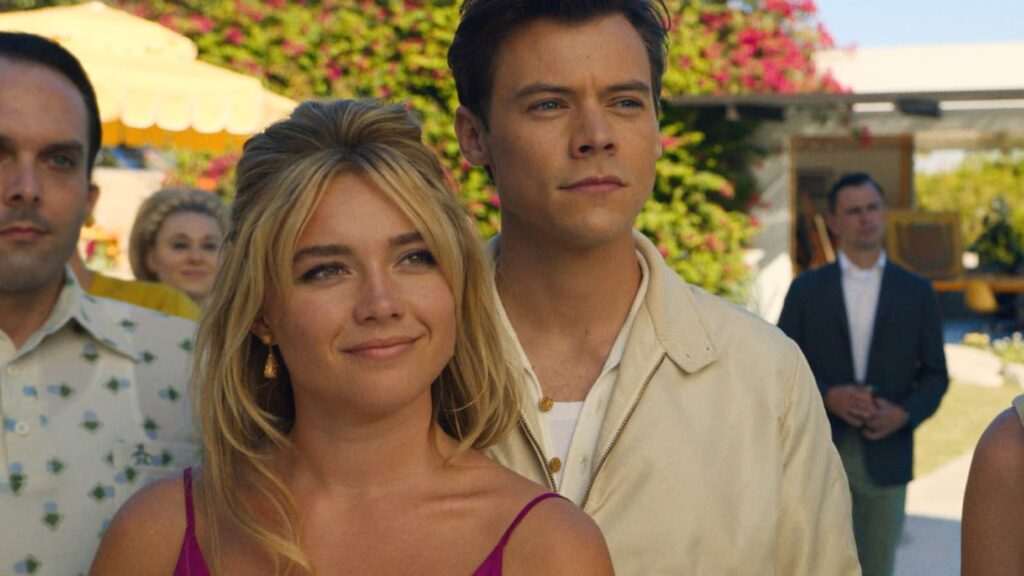
Coming soon in the candy-colored feminist gothic “Don’t Worry Darling,” director Olivia Wilde points her hand. The film is set in a desert town, Victory, where everything appears perfect and pretty, including the mid-century homes on the end of a cul-de-sac. It is a pleasant neighborhood and, provided that the story is set in the 1950s, more diverse than you might think. However Wilde lets you know straight away that there is something wrong here: everything is too tidy, too uniform and too, too good, including the women’s smiles.
Shy, bold, flirtatious or mocking, a woman’s smile is full of meaning, which Wilde, actress turned director, knows very well. It can be a mystery, an invitation, a deviation; sometimes it is a reward, even if it has a price. “It’s Sleeping Beauty’s smile that crowns Prince Charming’s efforts,” as Simone de Beauvoir writes in “The Second Sex,” with the captive princess’s gratitude validating the prince’s heroism. The men in the movie aren’t charming or heroic, but the women are constantly smiling, stretching their mouths so red lipstick it’s a surprise their faces don’t crack.
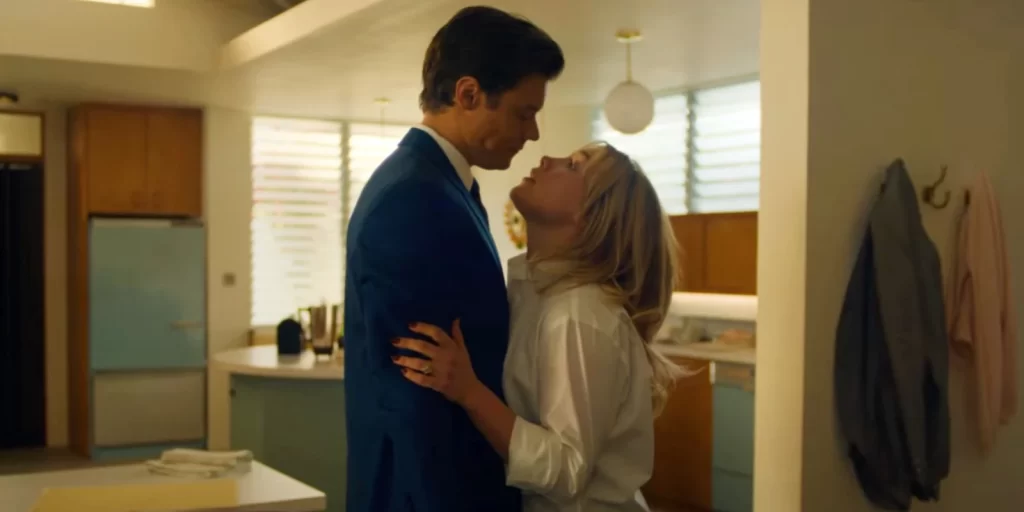
We do it, though it takes an interminable time for the cracks to become seismic. Something starts to bother Alice (Florence Pugh) soon after the film opens. She lives in the cul-de-sac and, like the other wives, she says goodbye to her husband, Jack (Harry Styles), as he drives to work. In the evening, cocktail in hand, Alice welcomes him, an impeccably groomed and dressed present that he eagerly unwraps. Much of the rest of the time, she cleans their home, polishing and vacuuming and washing the cinematography is suitably bright and crisp to the sound of a mysterious man’s buzzing voice.
It’s an intriguing setup. Everything has been polished to shine, including Wilde, who plays Bunny, one of Alice’s neighbors. But we quickly find the absence of waste, and especially the relative absence of these agents of chaos, alias children. There’s a touch of Stepford to this cheerful, bright place, and a touch of comedy to its excesses. But it’s obvious and brutal, and from the start, when the wives waved goodbye, all following similar choreography, I flashed on the evil planet in Madeleine L’Engle’s novel “A Wrinkle in Time”, where everything that shelters adults and children bounces balls, almost identical.
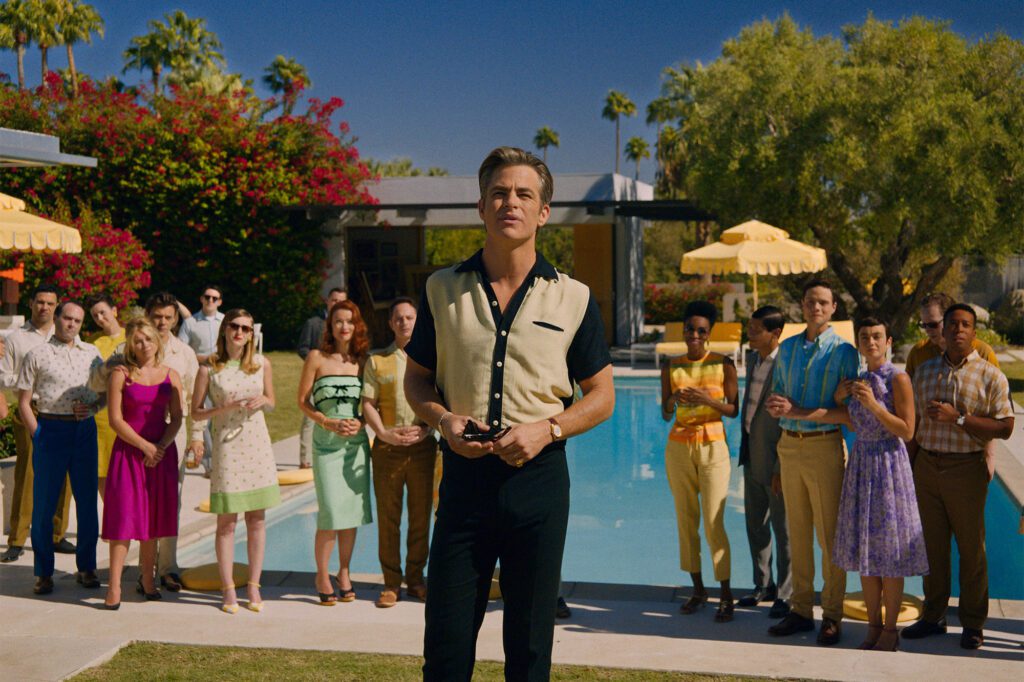
Alice has clearly fallen down an odd rabbit hole. But one problem with “Don’t Worry Darling” is that Wilde is so caught up in the world that she’s meticulously crafted with her colorful plating, martini glasses and James Bond poster she can’t let go. So, as Alice floats through her dream life, Wilde reveals this dollhouse, taking the character to a country club, on a wagon, and to visit Jack’s charismatic boss Frank (a silky, menacing Chris Pine) , whose home looks like a bachelor pad of an old Playboy issue, except this one is accompanied by a woman, Shelley (Gemma Chan).
Frank and his male staff’s high deference to her suggests there’s more to this world than her gleaming exterior, as do some period-inappropriate details, such as the topless girl walking by the pool in public and Alice wearing only a man’s shirt outside her front door. But even as the dissonance mounts and Alice realizes something is wrong, the film comes to a halt. Alice gets lost in thought, looks puzzled, hallucinates, looks less puzzled and so forth as Wilde embraces a visual motif – the circle – which after the second, third, fourth time she unfolds, loses its punch and usefulness, becoming an unintended metaphor for a film that keeps coming back to the same point.
The next day, Alice and Jack invite their neighbors, except Bunny and her husband Bill, to dinner, with Frank and Shelley as special guests. Frank speaks privately with Alice in the kitchen, confirming his suspicions and confessing to her that he was waiting for someone like her to challenge him in his creations. Alice tries to report him at dinner, but Frank gaslights her and makes her look crazy to the other guests. After dinner, Alice asks Jack to leave Victory. Jack appears to agree, but once in the car, Alice is taken away by Frank’s henchmen. Doctor Collins subjects her to electroconvulsive therapy, during which Alice has visions of herself in another life, where she is, at present, a hard-living surgeon named Alice Warren, with Jack, who is unemployed.
May Also Like : When Will Oddballs Release Date?
Don’t Worry Darling Ending Explained
Part of the confusion might be because the original script, which landed on the blacklist in 2019, was quite different. According to Insider, the script for Dick Van Dyke’s grandsons, Carey and Shane Van Dyke, was rewritten by “Booksmart” screenwriter Katie Silberman, who made some significant changes. This is a breakdown of what happens in “Don’t Worry Darling,” so far as we can tell.
What Is About The Build-up?
It’s probably clear to viewers that while Victory looks like a neighborhood from the 1950s, it does not actually occur in that era. The characters have a more laid-back approach to sex and nudity than you might expect from this suppressed decade (one scene finds a topless girl wandering around the neighborhood pool), and there are no cultural references specific to the period. It’s established quite quickly that KiKi Layne’s character, Margaret, one of the few POCs in the neighborhood, was taken away by unseen forces after questioning the system too much.
After Alice repeatedly asks what happens in Victory – and why nothing is real, including the eggs she cracks that have nothing inside – it is revealed that Project Victory is a simulation, much like a highly developed virtual reality. Alice and her husband Jack (Harry Styles) actually live in the real world in a modest home. Alice works late nights at the hospital and is often too tired to show Jack any affection when she comes home. Jack is unemployed. Alice’s work schedule and Jack’s lack of purpose drove a wedge between them, with Jack feeling neglected by Alice. Jack is seen spending his days listening to online videos of an incel-like internet character named Frank (Chris Pine), who has created cutting-edge technology that allows women and men to live in a simulation of a utopian 1950s neighborhood.
Though not explicitly shown, it is strongly implied that Jack, feeling completely alienated from Alice and wanting to keep control over her, kidnaps and holds her against her will to allow them both to get into the simulation and live a happier life. Alice has no autonomy in this decision. A montage reveals Jack signing up for the Victory simulation and choosing to give himself a British identity inside the fake world. Once Jack has Alice captive, he ties her to the bed and uses futuristic technology to upload her into the Victory simulation.
Jack uses this same technology to voluntarily enter the simulation. Jack is aware of his real self inside the simulation, but Alice and the other women are not. It is implied that all of these women are held captive by their toxic male partners and uploaded into the simulation to allow them to be the perfect wives. The only woman who knows what is going on is Bunny (Olivia Wilde), who reveals that she agreed to sign up for the real-world Project Victory after her children died. In the simulation, Bunny has two children (well, digital children) and lives happily. Bunny never told Alice the truth.
What is about the attack?
Once Alice learns of the above information, she goes rogue and hits Jack over the head with a drink. Bunny introduces herself and explains that if you kill someone in the simulation, they also die in real life. If Alice exits the simulation (which is achieved by going to Victory’s headquarters and touching a window, which acts as a kind of exit portal), then she will be able to expose the men’s criminal acts. Victory’s security henchman shows up and tries to kill Alice so her real body will not wake up and reveal the truth concerning the project.
Don’t Worry Darling : The Escape
In the final set-piece, Alice hitches Jack’s car and races across the desert to Victory’s headquarters in an effort to escape all the misogynistic mishegas once and for all. Frank listens to the chase updates, but is stabbed by his wife, who tells him, “It’s my turn now.” It is unclear whether or not Frank’s wife was like Bunny and knew the truth about Victory.
Either she didn’t know the truth and killed her husband for keeping her prisoner, or she knew the truth and killed her husband so she could play the victim card in the real world and not be responsible for any crime. Once Alice reaches Victory’s headquarters, she has a vision of Jack telling her to stay in Victory and be with him. She doesn’t listen and instead touches the glass which presumably teleports her consciousness into her real body. When Alice touches the glass, the film ends abruptly. The last shot of the film is a black screen. The viewer hears a woman gasping for breath, implying that she has woken up in the real world.