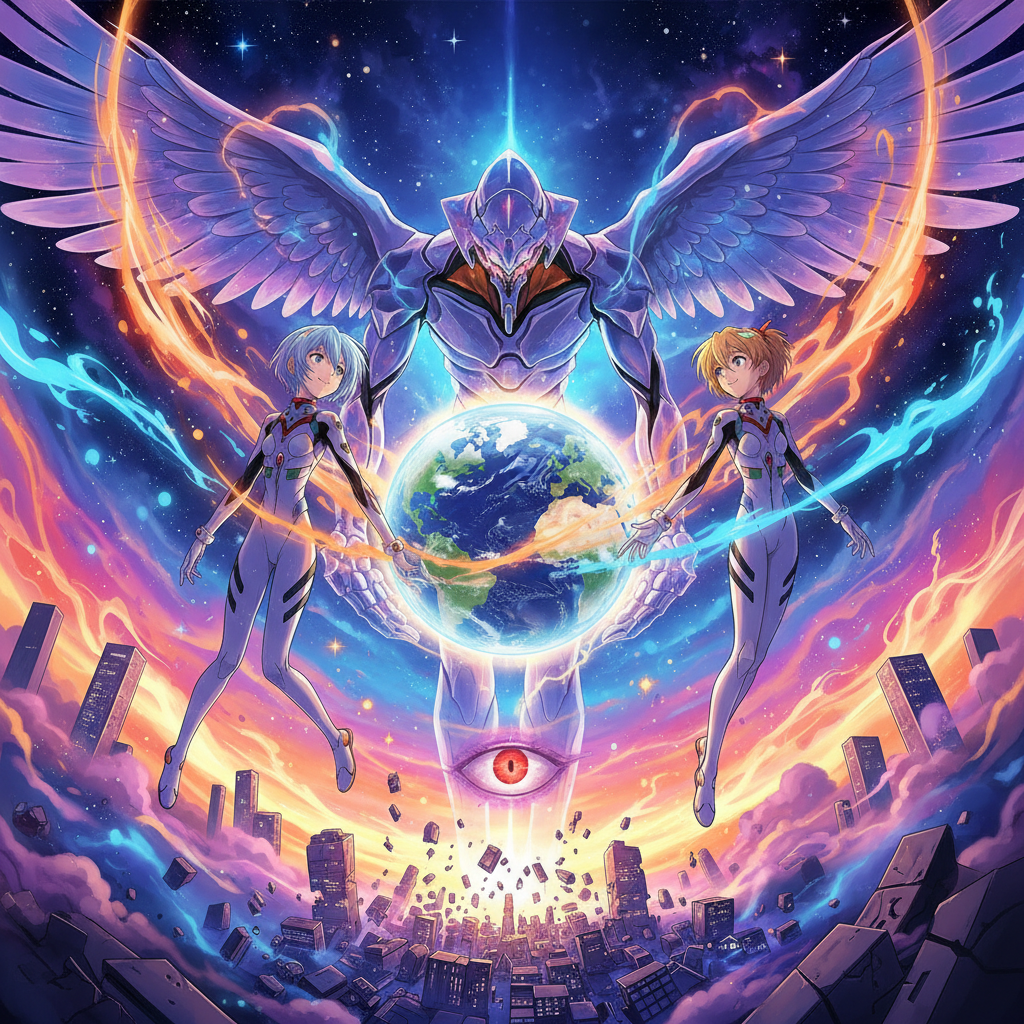
Okay, let’s get to an incredibly confusing endings in Animethe series – Neon Genesis Evangelion. Rumors circulate about them being close to the deadline, not having money, etc. etc. However, director Hideaki Anno has now come out and stated that the ending was created “as intended”. While production was going on the director’s thoughts changedin a way that was the result of a psychology book which a friend gave him. The result is what we saw.
What actually Happened in Evangelion ?
To be able to make this claim, the only source we’ll think of as for canons are the initial 26 episodes anime . I will discuss the film “End of Evangelion”.
There’s a wealth of mythology so here’s the background in a brief manner. I’m going to talk in very simplified terms and let you be aware of the fact that there’s some controversy over some particulars that I will not go into.
What You’ve Gotta Know
The bodies and souls are separate from each other. The soul may create its own body out of a specific chemical (think of it as the primordial liquid) or may be in an appropriate vessel.
In the past, thousands of years ago, there was an alien race was at the edge of devastation. They took their souls out of their bodies, kept them in ships and created beings that could travel to other planets, and then populate these with vessels in which this alien race could reincarnate in. They are known as”the “Seeds of Life”. (Still are you with me?)
Two of these ships are landed on the primordial earth. First, the Seed of Life, Adam comes to earth. Another Seed of Life, Lilith comes in a short time. Each of the ships is protected by a self-defense weapon. In the series , they are known as”the “Lance of Longinus” by people (they appear similar to spears). Lilith’s armor is damaged or destroyed during her collision with Earth.
There is a standard in their programming that there is only the one Seed of Life can be present on any given planet, which is why that the Lance of Longinus automatically incapacitates Adam.
Lilith starts to produce offspring and that’s the majority of existence on Earth.
In the end, Adam’s remains are discovered at the bottom of Antarctica. The spear is taken off and Adam (it?) awakes.
A person is trying attempt to “connect” with it. There is debate about that this is essentially shedding their physical appearance and blending the soul of Adams. The process doesn’t go as plannedwhen Adam is about to explode. they attempt to push the spear back in , but they’re too late. Antarctica explodesand wipes out everything living in a vast area (down to the microscopical level). This is the “Second Impact” thing they are discussing.
The result of the explosion, Adam’s body and his spirit were separated. It’s the body that’s disgusting animal fetus which Ryoji (the unassuming spy) escapes from. The spirit is put into an animal (later we’ll call him “Kaworu”) and SEELE manages both.
In simple terms, angels, the descendants of Adam begin to be born and attempt to wipe out humanity as well as Lilith.
The group dubbed “SEELE” has this plan. They got hold of the manual of instruction from one of the ships of the Seeds of Life. They refer to it as”the “Dead Sea Scrolls”. They know at least, the situation. They come up with this ideaThey want to see all humanity lose their physical body and join with Lilith. This is the “Human Instrumentality Project” they discuss. “Instrumentality” is the term they employ to refer to “all of humanity as souls, merged together”.
It is important to note that it’s possible that SEELE simply wanted ITS members to unite to form an Eva and then become gods.
Evas all are clones to Adam apart from Unit 01 Shinji’s Eva. It’s actually the clone of Lilith. They do not possess an actual soul, but they serve as a vessel for the soul.
Remember that I mentioned that souls and bodies are independent from one another? Therefore, all of Evas receive an individual soul through the “contact” method. Yuki Ikari (Shinji’s mom) is in Unit 01, and Asuka’s mother is in Unit 2 (wellshe’s the soul of Asuka is in Unit 02. This is why her mom is insane). It’s unclear who’s in Unit 00, however there is a suggestion that it could have been Rei (the the first Rei one, who died as a young child). This is the reason all characters are able to only operate the Evas of their respective Evas. They’re basically connecting with their mother’s souls.
Let’s discuss Rei
She’s a strange one. So Shinji’s mother, Yuki Ikari, has her soul enter Unit 01. The remains are basically put into an object. The first Rei (there are a lot of copies) is most likely the remains of Yuki. The latter ones are containers for the souls. They also have Lilith’s (the Seed of Life) soul within it (or some in it).
The last time I wrote, I talked about “special substances” that substance that souls can build an entire body from. If the soul was born from Lilith the substance is referred to as “LCL” in the series (it’s the breathable liquid inside the plug for entry). In the event that it’s soul born from Adam it’s named “Particle-Wave Matter” (PWM). This is what angels are made of. It’s gross, however NERV collects from the blood of Lilith in order to produce LCL.
We are now in the main storyline. The Angels (Adam’s children) are seeking to eliminate humanity and Lilith to ensure that they thrive as they were intended to do originally. They are trying to kill Lilith and are kept in the lowest levels of NERV headquarters to ensure she doesn’t produce any more children. This is the reason why Tokyo 3 keeps getting attacked.
Shinji piloting an Lilith base Eva is fighting a group of Angels and ends up killing them.
Something to do with Adam or Lilith.
There were apparently there were two “types” of Seed of Life. Adam is one of the “Fruit of Life” type and Lilith is an “Fruit of Knowledge” type. The ancient alien race split into two because if children of an Fruit of Life and Fruit of Knowledge type ever joined, they’d be just as powerful as the ancient race of aliens (basically being gods).
“The “Fruit of Knowledge” is fundamentally “the power to do science and technology” and is the power that humanity has. “The “Fruit of Life” is basically unlimited power, and that’s the power that Angels possess.
There are many things that happen but the most important thing is Eva Unit 01 (remember- Lilith is the basis) is the organ that Eva Unit 01 takes from the angels and consumes it. This is the “Fruit of Life”. It’s known by the name of “S2 engine” in the series (they use a number of biological items mechanical names – it’s an organ). Thus Unit 01 is now basically: Yui’s soul inside it as well as elements from Lilith (Fruit of Wisdom) as well as parts from Adam (the “Fruit of Life”). This makes it an unborn god (power equal to the super-powerful antiquated extraterrestrial race).
An article about “AT Fields”.
They are basically the barriers that your soul faces (rememberthat the soul and the vessel are separate). The term “AT Field” refers to the “AT Field” is basically what keeps a soul inside its body and keeps the vessel from looking exactly as it appears like. Imagine it as an… self-image. Adam is the “Anti-AT Field” which can liberate souls from their vessels. Eva Unit 01, once it has consumed that S2 engine, is now able to effectively perform an Anti-AT field.
Let’s discuss Kaworu Nagisa for just a minute
He’s basically Adam’s soul inside another vessel. He’s referred to as”the “17th Angel” but he’s not actually or even an “angel” per se. (Adam along with Lilith are race-making machines referred to as “Seeds of Life”.) He is there because SEELE who are in charge of him, is looking to start the “Human Instrumentality Project” (rememberthat they want to free all souls, bring humanity back together, etc.). I’m skipping over a few things but they’ll need Unit 01 to be the catalyst.
So Kaworu becomes acquainted with Shinji. He enters NERV to attempt to rescue Adam but discovers that they are Lilith but not Adam. If Kaworu combined with Lilith the world would explode and everyone could die. Shinji holds him by his robot, and Kaworu decides not to end the world as it’s a decent race. Kaworu asks Shinji to kill him to ensure that it won’t be used to end the human race. Squish, music blood, scream credits for the roll.
The two episodes that have been a bit bizarre are actually just happening inside Shinji’s brain. In essence, avoid the episodes. They are impactful, however… it’s not much.
Let’s discuss the film “End of Evangelion”
The basic idea is that the Human Instrumentality Project happens anyway due to some events that resulted within”the “Third Impact”. (Basically, Adam and Lilith eventually got together after Gendo put the Adam embryo into Rei.) The result is “freeing of all the souls of Lilith-based lifeforms” (humans). Shinji from Eva Unit 01, who was the main catalyst in the whole thing was spared and is requested from the newly created god (it’s strange… Rei, Lilith and a bit of an Adam hybrid) whether he wishes for all humanity to merge. He considers his opinions about the subject and decides it’s ideal if everyone were an individual. It’s not much help since everyone has quit their bodies in the form of “died” so it’s basically only him and Asuka sitting on a beach an uninhabited planet. This implies that in the future, all of humanity’s souls could be reincarnated into new vessels in the future.
That’s right, is it.
The basic idea is that Evangelion is a story of two aliens who inhabit the same planet through accidental contact with the souls of their friends who died by creating vessels that they can become reincarnated. They argue, Shinji whines a bit before they unite, and then they conclude that all is absurd and cut the whole thing off.
The End of the World – Episode 25
Gainax/Netflix
The strings and bare bones of plot left when “Neon Genesis Evangelion” gets to its final two episodes, they are totally discarded and the show takes on a dramatic change into something that is truly inspirational and absurd.
It is disclosed it was Gendo and SEELE were working on creating the Human Instrumentality Project, a huge, pseudo-Biblical endeavor in which humanity’s souls are merged into a singular human consciousness. For Shinji this confluence of conscience is described as a sequence of dream-like vignettes or a subliminal therapy program which makes Shinji to examine the reality of his identity, and position in the world.
Episode 25, which is the 25th and final episode, starts with the titles that are titled Raison D’etre – The reason for being Shinji Ikari’s Case. Shinji Ikari. The life of Shinji and memories, the difficult relationship he has with his mother and his friends such as Asuka, Rei, Misato Katsuragi as well as Toji Suzuhara interspersed throughout with titles that ask personal questions, some of them from different characters and some from an unidentified Narrator. It’s not difficult to think that the narrator could be Anno his self, and he has suggested that the last two episodes were the culmination of his own thoughts about himself. He also said that he didn’t initially believe that he needed or wanted to draw and preferred doing it with words. For some the portrayal of mental illness and trauma life events is scary and cold, but nonetheless relatable and inspiring.
The End of the Fantasy – Episode 26
Gainax/Netflix
The themes of separation, abandonment and loss are a heavy theme on the sleeves of the film, and it’s in fact an emotional drama disguised as an action-packed Mecha-anime. This film Human Instrumentality Project for Shinji’s father Gendo is a way to bring about a conclusion which is to reunite souls of humans also means reuniting and his spouse (and the mother of Shinji) Yui who was killed during the Second Impact, a cataclysmic event that nearly destroyed entire world and divided humanity. In the present, the Instrumentality Project is coinciding with the Third Impact, another Biblical-level event, one that transforms humanity into one.
Episode 26 deals with Shinji’s decision to follow his path. at the same time, it outlines the ways that the story and its conclusion can be interpreted in relation to real life. The majority of the episode is spent it creating a new world for Shinji who is not a kid who has to be a pilot in an EVA and is instead a normal school child. He is a happy father and mother as well as cool and cool-looking friends and his life is exactly like every other. Anno abruptly and in a confrontational way causes a separation between his art from his real-life by asking his audience in direct communication. It’s not just about just fantasies — live them!
It’s Only The End If You Let It Be
Gainax/Netflix
As artists develop in their philosophy and views of the world and art Reflections of this can be evident within the people and philosophies that are depicted in their works. The case for “Neon Genesis Evangelion,” the Human Instrumentality Project was but one of the possible endings to the multiple reality.
Evangelion has seen many finales, one of which was in the show, another in a different film “End of Evangelion,” and even a third one in”Rebuild,” the “Rebuild” movie series with the movie “Evangelion 3.0+1.0 Thrice Upon a Time,” each with various conclusions or fake-conclusions of the tale.
These diverse storylines are in tune with various aspects of Anno’s personal life. As producer, Hideaki Anno has mentioned in many conversations that his work is his personal life, and so, as his personal life is ongoing and the show continues to evolve, so does the show.
The show debunks the notion the idea that “Neon Genesis Evangelion” is an end-of-the-line story, or even a tale worthy of having a bow tied around it. The most striking aspect that is “Evangelion” is how it is an ever-changing mythos created by Anno who is occasional visitors to its bizarre world and the creator’s nebulous mind.
The ending of Evangelion television series in movie End of Evangelion movie
In the final episode of the show, Shinji is able to overcome his self-loathing with success, as are Asuka, Misato, and likely the rest of humanity. But, you might be awed by the way that Shinji’s journey is depicted in abstract style, with line animations and, sometimes, simple colored markers.
There are a variety of reports regarding the reason for this According to anonymous sources, the show’s creators had difficulty finding that the show faced difficulties getting (or better maintaining) sponsors, resulting in the need to outsource production and the budget dwindling during the final third of the show the director Hideaki Anno claims to put the blame on scheduling issues triggered by television networks and would have left the crew with no time to complete the episode as well as The fact that explicit content and violence that was a part of the run of Evangelion could result in the strictest standards of broadcast censorship and the studio’s founder president Toshio Okada said Anno was unable to make his choice in a timely manner.
Whatever the reason the strikingly different animation style is viewed as a practical storytelling tool. As Shinji is drawn deeper and deeper into himself, removing his defensiveness, so the visuals are stripped through the processes of making an animation. Shinji examines the lives of the people around him and realizes that they’re too suffering, just like Shinji is, and it’s not appropriate for him to depend on them to solve his problems. In a half-dialogue and half-lecture, which resembles an actual therapy session Shinji recognizes that his self-hatred has affected his relationship with people.
A significant part of the journey is travelling to a blank page, which symbolizes complete and complete freedom in self-definition. However, that’s a lot for the human mind especially a teenager to comprehend. Then, slowly it’s a short glimpse into a world in which Shinji and his fellow students are as happy as regular teens in high schools.
Imagine it as an evocative version of the “Ghost of Christmas Yet to Come” sequence, but more optimistic; instead of showing Shinji the dreadful outcome that could occur in the event that he follows his current course (that’s End of Evangelion, for more details in a moment) It shows Shinji as a person who has had a great time and is happy. This particular scene is significant for the entire franchise since it hints at the possibility of a canonical multiverse, which would allow creators to later put the characters in a variety of settings and genres but the main purpose of the moment is to break Shinji from a feeling of being stuck.
While perhaps a slight exaggeration–learning to love yourself won’t bring your parents back from the dead, for instance–it illustrates for him that he can change his own perceptions and thus himself. When he has had this moment of clarity that opens the world metaphorically and reveals all possible healthy connections accessible to Shinji. This episode uses the last glimmer of energy to scale back to full animation, and bring life and color into the world of Shinji to complement his renewed determination.
In the End of Evangelion, however, Shinji rejects the concept of growth. This ending represents the darker yin in the anime’s more positive Yang. As Instrumentality starts Shinji is shown distorted versions of scenes featuring Misato and Asuka which, as in the ending of the TV show helped him understand his suffering. In this case, it only accentuates his sexism, since it is difficult for him to seeing their actions as a result and interprets their words as a threat. The camera light used as a metaphor for light in the final scene of the TV show is shown in a new way, only it’s dim and inactive. It even shows Gendo repeating the same phrases about the fear of others as he passes away and revealing a dark image of the person Shinji is likely to become: bitter angry, abusive and obsessed.
He imagines a mental image of Asuka who reveals to him the brutal truths: that his affection for her is unpersonal, not interested in her issues and is only used to keep him upright. Unwilling or unable to acknowledge this, he snatches her. Furthermore, since his attitude is the reason for Instrumentality that it is defined by human pain and fear, rather than growth and understanding. When Shinji questions whether his existence is meaningful as it was discussed and confirmed in the TV final episode of the series, he is not able to get an answer.
Shinji is guided by ghosts of Rei and Kaworu which symbolize the hope and love in his heart, respectively. They try to convey their message in the show’s finale and Shinji is aware that he’s trying to help others, but because he’s unable to confront himself, it’s bound to fail. Shinji thinks that he’ll discover the same mistake “over and over” as He is cut off from the sea of humanity, and wakes on the sandy beach along with Asuka.
After a lot of emphasis on the fact that humans use hands to reach out and connect with each other The camera focuses between the hands of the couple near enough for them to be touching yet a world away.
Contrasting with the vague and hopeful conclusion of the show, that updated English dub goes as far as to overlay Misato as well as Asuka’s voice over the phrase “I can change and like myself” to suggest that everyone in the cast is at the point of completion and healing. However, the film does not support Shinji’s claim to make a fresh start. Although he claims he wants to attempt to be a part of a community the first thing Shinji does upon encountering Asuka is to attempt to strangle her.
It’s a reversal of his previous decision earlier in the film that started the sequence of global sadness and despair. This return to the same scene based on his instincts implies that he’s gained nothing and made no change and, at the very least, will continue to follow the same path until a new breakdown, and will have another chance to alternatively.
The final scene does offer some hope, in the fact that Shinji is stopped after Asuka is able to reach out and touch him. This could be thought of as Shinji finally deciding to not hurt Asuka and feel emotion (as shown by his tears) instead of continuing to keep everything in check however this major change comes at the cost of the devastation that has just occurred. It’s a bittersweet conclusion in comparison to the television series and only offers the tiniest hint of hope following the final day of the world.
However, some interpret the event as a dark and bleak event in which Shinji did not stop until Shinji was in a state of depression, paralysis and self-loathing devouring his soul. The popular thought behind this interpretation of the final scene can be explained as Anno offering fans who were unhappy with the ending of the show “what they wanted” in an ape’s paw situation Here it is, which is the exact opposite of the way things went prior to. Enjoy.
The Real-World Reasons Behind Evangelion’s Ending
The many complicated elements, divergent endings, and dramatically divergent style of visuals (like the use of hand-drawn sketches and live-action elements) all have a connection to the reported problems with production of the first anime series.
Director Hideaki Anno was reportedly fighting depression for a long time during the creation of his Neon Genesis Evangelion series. The team had a difficult time of it due to a stressful production, as well as issues with sponsors which would ultimately result in the notoriously sluggish animation in the final episodes. Before the final episode was filmed, Anno was given a book on mental illnesses by a friend which was the closest thing to an understanding of his own problems.
The experience formed the foundation of the show’s conclusion, and also conveys an optimism about the possibility of healing. “I wrote about myself,” Anno stated to Newtype in a translation of the interview conducted by CJAS. “My friend lent me a book on psychological illness and this gave me a shock, as if I finally found what I needed to say.”
While the show’s ending was based on the positive experience of the creator of the show and creator, a section of fans were not satisfied at the end. Some felt that the show was a bit unsatisfactory due to its lack of animation and an emphasis on the inner journey of Shinji rather than the actual details of the apocalypse. some debated whether the show’s ending was a tribute to Anno’s vision, or a denial to loyal fans that did not meet their expectations or loyalty.Pokemon Masters Gameplay Details Revealed1:08Autoplay setting: OnThis legendary intensity has become an epoch that is as strong as the show itself. angered by Anno’s habit over the years of making unclear or outright contradictory comments in interviews.
However, we can create an approximate timeline to the scandal that transpired through various reports throughout the years. The finale of the TV series aired in March of 1996 and in the month of July 1997 End of Evangelion was released. There are some who claim that Anno created End of Evangelion specifically in response to the negative reception of the finale on TV and others claim that the studio’s artists were eager to develop further Evangelion and were pushed to make the show to continue. However, whatever the case the negative reaction to the events of Evangelion had taken full swing and even saw the production studio Gainax be threatened with death by viewers.
Anno’s reaction was to give an entirely different ending to counter the backlash of fans who claimed that turning to fantasy leads to an end to the universe. It hampers human understanding and inevitably leads Shinji to repeat the same mistakes again and repeatedly, rather than advancing. This is why the live-action scene of a cinema during the film’s Instrumentality sequence that is the last part of the film and the reason there are letters displayed on the screen. They are actually a list of death threats that the studio received. The film that resulted is a heartbreaking but sincere one, which contrasts Rei and Kaworu’s words with the corrosive negative effects of not allowing the truth about oneself: it led to the transition from a set of films titled “Do You Love Me/Take Care of Yourself” to “Love is Destructive/I Need You.”
To emphasize the message To make the point clear, the transition to the live-action scenes of the film include an array of scathing dialog from female characters in the film The character of End of Evangelion Shinji has a negative view and disapproves of females in his world as shown by the way that the camera’s lens focuses on their breasts or fantasies about naked women as they attempt to bring Shinji to his feet for not paying attention to them during the train scene. The ending is a direct and direct reaction to the fans of anime who reacted with anger at Anno.
As the Deputy Director Kazuya Tsurumaki wrote in the book The End of Evangelion: Theatrical Program book “For instance, Hideaki Anno has said that anime fans are introverted and should be more active. In addition He should be content that there are people who don’t like anime watching his work, isn’t it? However, when all is done and dusted, Hideaki Anno’s comments on the two endings of Evangelion are that they are an attempt to reach out to anime enthusiasts, which includes him, and of course, me as well. Also, it’s not worth it for people who aren’t anime fans to go and watch the film. If a person who live and speak typically watch it, they won’t gain anything from it.”