Kantara Ending Explained. Kantara is a 2022 Indian Kannada-language action thriller film written and directed by Rishab Shetty, and produced by Vijay Kiragandur, under Hombale Films. The film stars Shetty as a Kambala champion, who comes to loggerheads with an upright DRFO officer, Murali. Achyuth Kumar and Sapthami Gowda feature in supporting roles.
Set and filmed in Keraadi in coastal Karnataka, principal photography began in August 2021. The cinematography was handled by Arvind S. Kashyap, with B. Ajaneesh Loknath scoring music for the film and the action sequences were choreographed by the two-time National Award-winning action director Vikram More. The production design was handled by debutant, Dharani Gange Putra.
PLOT OF KANTARA

Kantara Ending Explained. In 1847, the king agrees with Panjurli Daiva/Bhoota (an Animist form of spirit worshipped by the locals of Udupi/Mangalore region, some parts of the western ghats of Karnataka and Kasargod district of Northern Kerala) to trade the forest land to the local tribespeople in exchange for peace and happiness by Daiva. Though the Daiva agrees, the tribal people warn the king that the family of the Daiva would follow the deity and any attempt to go back on the word will incur the wrath of the Guliga Daiva. In 1970, the king’s successor gets consumed by greed and demands the tribal people to give the land back during the Bhoota Kola festival and warns about going to court, but after a few months dies a mysterious death.
In 1990, Muralidhar is a forest officer, who wants the forest land to be untouched, but is challenged by a Kambala athlete named Kaadubettu Shiva, along with the backing of his master and the village’s landlord Devendra Suttooru, who is the son of the king’s successor in the present day. Murali and Shiva are at loggerheads with each other and decide to protect the forest by fencing the forest land and makes Shiva’s girlfriend and a forest guard named Leela to convince the villagers, but they refuse and insult them, where they manage to fence the forest land and brutally suppress Shiva and the villagers. Meanwhile, Shiva is asked to perform the Bhoota Kola festival, but he refuses as his father disappeared in front of him while performing the rituals.

While roaming around the forest with Devendra to meet the former’s girlfriend, Shiva witnesses the deity that always occurs in his dreams and runs away in fear, along with Devendra. Due to ego, Murali decides to arrest Shiva and his friends, where he heads to their hideout along with Devendra’s henchman Sudhakara. However, Shiva and friends went into hiding, but are later captured and imprisoned. When Shiva’s cousin-brother Guruva requests Devendra to release Shiva, the latter tells him to make the villagers believe that the Daiva wants them to sell their land to Devendra, but Guruva refuses due to which Devendra kills him. It is revealed that Devendra wanted to seek vengeance against the Daiva and the villagers for killing his father, where he wants the villagers to sell their land to him.
May Also Like: Devil’s Workshop Ending Explained: What’s Happened?
KANTARA REVIEW

Kantara excels when it focuses on Shiva but flounders while depicting the other characters. Murali, for instance, a cop just doing his job, is propped up as a needless villain. He so sorely lacks an inner life, or any shred of complexity, that he looks like a type, shutting all doors of engagement. It feels all the more contradictory because, as we find out, he isn’t a bad guy at all. Even the role reversal of the landlord (Achyuth Kumar) — a seemingly nice guy turned evil — fails to shock or surprise, as Shetty doesn’t hide his vile intentions well. Shiva’s lack of convincing relationships with these people, including his cousin Guruva (Swaraj Shetty) — the deity incarnate in the Bhoota Kala festival, who is later murdered — keeps making Kantara lopsided.
Which is why its long middle segment struggles to elicit a poignant reaction. The film regains its vigor and emotional power in the last 30 minutes, when it embraces its strength: dazzling set-pieces. Its climactic arc is a thing of bewitching beauty, following its own three-act structure: betrayal, resolution, beginning. The devices return — blood drips, sickles swish, eyes pop — making you crave more.
Arvind Kashyap’s cinematography is so assured and kinetic that it doubles up as performance. In one fight sequence, shot in a puddle on a rainy night, the camera makes a rapid circular motion, upending the frame, heightening the violent dance. These scenes underscore Kantara’s most resounding roar: that a benevolent ruler is still a ruler – that rights robbed will be robbed back. This climactic frenzy also rings with circular irony, as it contradicts the reason sparking the inter-generational conflict: a dissatisfied man looking for inner peace.
KANTARA: ENDING EXPLAINED

Kantara Ending Explained. In the film’s final scenes, the tension between Shiva and Murali attains its peak when a huge tree in the forest falls on Murali’s car, while he was headed to arrest Shiva after the landlord’s henchman, Sudhakara (Pramod Shetty) provided a tip. The landlord instructs Shiva to run but he is soon arrested along with his friends. Things intensify when it is discovered that Shiva’s brother Guruvan the Kola performer has been murdered.
The landlord, Devendra Suttooru (Achyuth Kumar), is behind the murder because just like his father, he believes the villagers and the performer created a story to deprive him of his ancestral land. However, the villagers, at this point, are unaware of this. Meanwhile, while making efforts to convert the forest into a reserved forest, Murali comes to know that the landlord has illegally taken control of the entire land in his name. Shiva soon finds out about his brother’s murder and the landlord bails him out to get Shiva by his side, while lying to him that Murali killed his brother.
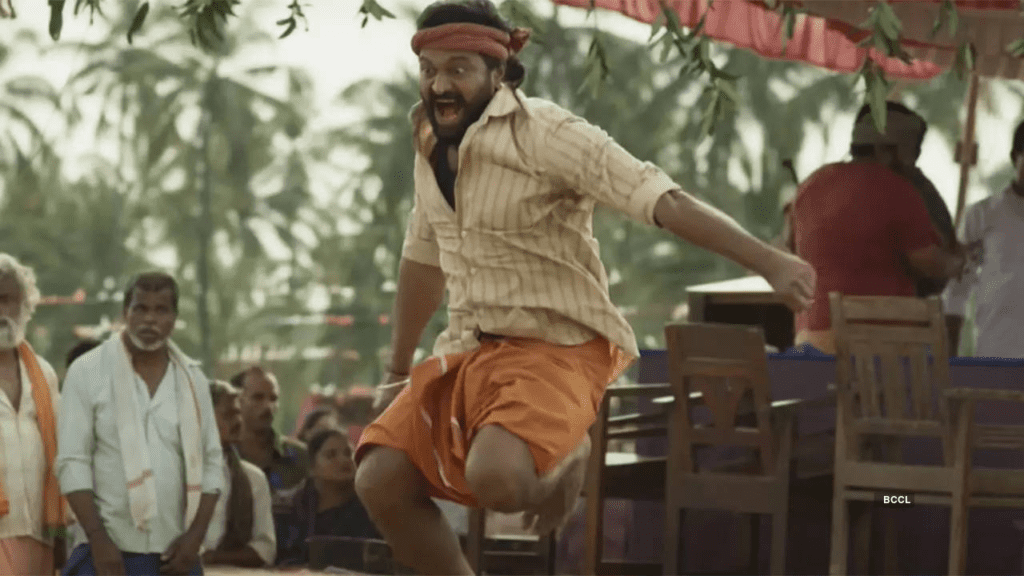
However, Shiva’s mentor informs him the truth behind Guruvan’s murder and he heads back to inform the villagers. There, Shiva finds Murali, who is already informing the villagers of the landlord’s misdeeds. Shiva joins hands with Murali as the landlord is on his way to kill the villagers, including Shiva and Murali. Following a clash, Shiva passes out after getting severely wounded. Soon, the Guligan deity possesses him giving him immense strength and he decapitates the landlord and his henchmen.
The film ends with Shiva accepting his role as the Kola performer possessed by Panjurli for the Bhoota Kola festival. He yearns for peace between Murali and the other villagers. Shiva runs off to the forest and seemingly finds his father and disappears into the light.
The Conflict Between The Villagers And The Police

Kantara Ending Explained. “Kantara” starts in 1947 when a King grants the forest land to the local tribes in exchange for peace and protection by their God—the Panjurli Daiva. He is warned that though the families will continue to serve the God, any attempt to go back on his word will incur the wrath of the God. Cut to 1970: The descendant of the King wants the land back. He asks for it at the Bhoota Kola festival. It is essentially a coming together of music, dance, recital, and costumes. The person performing it is Shiva’s father, and it is indicated that he is possessed by the God himself at this time. In the discussion between the King’s descendant and the vessel of the God, “Kantara” made the creative decision to keep the latter’s dialogues in Kannada while translating only the former’s words.
We could understand that in their exchange, Shiva’s father had warned him about the consequences of withdrawing from the promise of his ancestor and had subsequently run off into the forest and disappeared in a burst of flames. A few months later, the man dies while in the middle of the process of reclaiming the land.