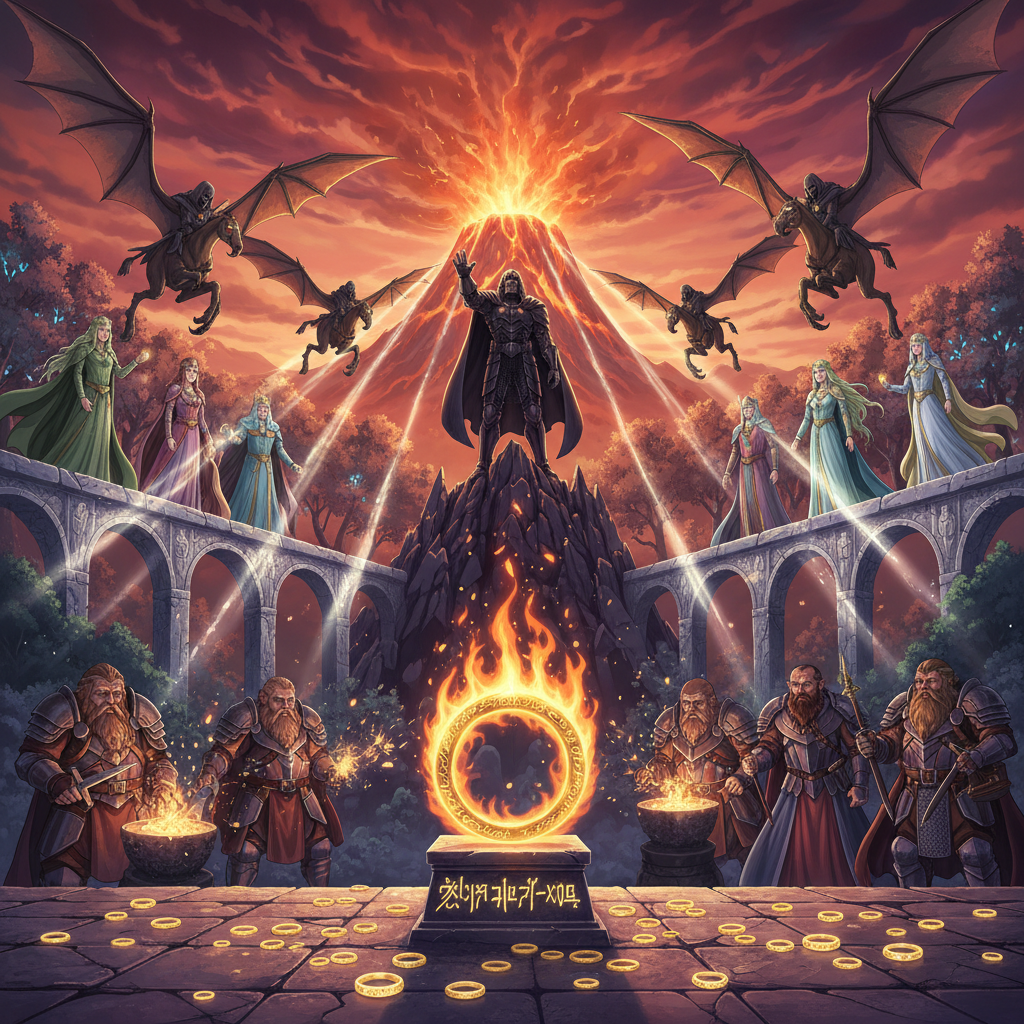
There are many rings in Tolkien’s The Lord of the Rings mythology, but not all of them are described in detail. In this article, we will be describing all the known and lesser power rings from Middle-earth. How many Rings of Power can you find in The Lord of the Rings?
The Lord of the Rings contains 20 known rings of power. Sauron initiated the creation of 16 rings in total including the most powerful “the One Ring”, while the remaining three rings of power were crafted by Celebrimbor.
There are many lesser known rings that can be used in addition to the 20 power rings. We will also discuss them here. Let’s see what are those 20 rings of power in the Lord of the Rings series, what can they do, how powerful they are, and who wields them.
The One Ring
“One for the Dark Lord on his dark throne…”
The One Ring is a central plot element in J. R. R. Tolkien’s The Lord of the Rings (1954–55). The One Ring first appeared in The Hobbit (1937), as a magic ring that gives the wearer invisibility. Tolkien made it a malevolent Ring of Power, and rewrote some parts of The Hobbit in order to make them fit the expanded story. The Lord of the Rings describes the hobbit Frodo Baggins’s quest to destroy the Ring.
What are the powers and abilities of the One Ring
The Ring’s primary power was control of the other Rings of Power and domination of the wills of their users. The Ring also conferred power to dominate the wills of other beings whether they were wearing Rings or not—but only in proportion to the user’s native capacity. The Ring also increased the power of its owner.
A mortal wearing the Ring becomes virtually invisible to anyone but those who can perceive the non-physical realm. The only thing that is visible in bright sunlight is a faint shadow. The Ring extended the life span of mortal possessors indefinitely and prevented natural aging.
Gandalf explained that it did not “grant new life”, but that the possessor merely “continued” until life became unbearably wearisome. The Ring did not protect its bearer from destruction; Gollum perished in the Crack of Doom, and Sauron’s body was destroyed in the downfall of Númenor. The One Ring, just like the Nine Rings in its physical corruption, transformed mortals into wraiths.
This was more true for Hobbits than it was for Men. Gollum, who had the ring for 500+ years, didn’t become wraith-like as he rarely wore it. Except for Tom Bombadil and Gandalf who refused to wear it out of fear of becoming like Sauron, no one seemed to be immune from the destructive effects of the One Ring.
Within the land of Mordor where it was forged, the Ring’s power increased so significantly that even without wearing it the bearer could draw upon it, and could acquire an aura of terrible power.
When Sam encountered an Orc in the Tower of Cirith Ungol while holding the Ring, he appeared to the terrified Orc as a powerful warrior cloaked in the shadow “[holding] some nameless menace of power and doom”.
Similarly at Mount Doom, when Frodo and Sam were attacked by Gollum, Frodo grabbed the Ring and appeared as “a figure robed in white… [that] held a wheel of fire”. Frodo told Gollum “in a commanding voice” that “If you touch me ever again, you shall be cast yourself into the Fire of Doom”, a prophesy soon fulfilled.
As the Ring contained much of Sauron’s power, it was endowed with malevolent sentience. Although separated from Sauron the Ring attempted to return him by manipulating its bearer or abandoning it.
To master the Ring’s capabilities, a Ring-bearer would need a well-trained mind, a strong will, and great native power. People with weaker minds such as hobbits, lesser Men and others would not be able to benefit much from the Ring. Even for one with the necessary strength, it would have taken time to master the Ring’s power sufficiently to overthrow Sauron.
See also: American Horror Stories Season 2 Episode 5 Release DateYou are here!
The Ring did nothing to make the bearer of it omnipotent. Three times Sauron suffered military defeat while bearing the Ring, first by Gil-galad in the War of Sauron and the Elves, then by Ar-Pharazôn when Númenórean power so overawed his armies that they deserted him, and at the end of the Second Age with his personal defeat by Gil-galad and Elendil.
Tolkien suggests that such defeats would have been impossible in the last years of Third Age, when the strength of free peoples was greatly diminished. There were no remaining heroes of the stature of Gil-galad, Elendil, or Isildur; the strength of the Elves was fading and they were departing to the Blessed Realm; the Dwarves had been driven out of Moria and were unwilling to concentrate their strength in any event, and the Númenórean kingdoms had either declined or been destroyed and had few allies.
Three Rings
“Three rings for the Elven kings under the sky…”
Nenya
Nenya (Q, pron. [ˈneɲa]) was one of the Rings of Power, specifically one of the Three Rings of the Elves of Middle-earth. It is also known as the Ring of Adamant or the Ring of Water. It was made of mithril, and set with a white gemstone of adamant.
Celebrimbor of Eregion was the only one to make Nenya. He did so between c. S.A. 1500 and c. S.A. 1590. After Celebrimbor discovered that Sauron had forged the One Ring in S.A. 1600 he went to Lothlórien to seek the counsel of Galadriel.
Galadriel advised Celebrimbor that the Rings should be kept hidden and not destroyed so they were dispersed far from Eregion. Celebrimbor adopted this advice and gave Nenya to Galadriel. The power of this Ring strengthened and beautified the realm of Lothlórien, but it also increased Galadriel’s desire for the Sea and return to the West.
Galadriel’s ring was not visible in normal circumstances. T.A. 3019[7] Frodo Baggins saw Nenya on Galadriel’s finger, for it could not be hidden from the Ring-bearer. Samwise Gamgee told Galadriel he only “saw a star through your fingers”.
Nenya’s power was preservation, protection, and concealment from evil. The power of Nenya was weakened by the destruction of the One Ring and defeat of Sauron. Galadriel, along with the bearers of the Elven Rings and the bearers of their bearers, bore Nenya aboard a ship from Grey Havens to the West.[8] With Nenya gone, the magic and beauty of Lothlórien also faded and it was gradually depopulated until by the time Arwen came there to die in Fo.A. 121, it was in ruin and deserted.
Narya
Narya (pron. [ˈnarʲa]), the Ring of Fire or Red Ring, was one of the Rings of Power, specifically one of the “Three Rings for the Elven Kings under the sky”.
Created by Celebrimbor after Annatar had left Eregion, it was free of Annatar’s (Sauron’s) influence due to the fact that the Elves hid their three rings from him upon discerning his intent, but it was still bound to the One Ring.
In The Lord of the Rings and The Silmarillion, Gil-galad receives only Vilya, while Círdan receives Narya from the very beginning. In the Third Age, Círdan gave the ring to Gandalf for his labors.
According to the Unfinished Tales Narya was given to Gil-galad (High King of the Noldor) at the beginning of the War of the Elves. Gil-galad entrusted Narya to his lieutenant Círdan, Lord of the Havens of Mithlond, who kept it after Gil-galad’s death.
It’s described as having the ability to inspire others against tyranny and (commonly with the other Three Rings), concealing the wielder from distant observation (except by a wielder who is the One) as well resisting the weariness to time.
“Take this ring, master,” he said, “for your labors will be heavy; but it will support you in the weariness that you have taken upon yourself. For this is the Ring of Fire, and with it, you may rekindle hearts in a world that grows chill.”
― Círdan the Shipwright
Vilya
Vilya (Q, pron. [ˈviʎa]) or Wilya (pre-SA and Vanyarin, [ˈwiʎa]) was one of the Rings of Power. The Elves of Eregion made the Rings of Power (as a proper name). Narya, Nenya and Vilya were the Three Rings of the Elves. They were more powerful than the Rings of Power given to Dwarves and Men. Vilya was jewelled, just like the Elven Rings. It had a great, blue stone set in an 18-karat gold band. This helped to give it the titles of the Ring of Sapphire, and the Blue Ring.
See also: Season 24 Law And Order Special Victims Unit Release Date Expectations!
Vilya had a lesser-known title, the Ring of Air. This was to signify its superiority over the Rings of the Elves. It was generally believed that Vilya is the most powerful of the three bands.
Celebrimbor, the Lord of Eregion had created all Three Rings without Annatar, an incarnation of the Dark Lord Sauron, by S.A. 1590. Because of his evil, none of the Three were affected. However, like all the Rings of the Elves, Vilya was still under Sauron’s influence when he wielded The One Ring, which held dominion over all the others.
Celebrimbor was aware of Sauron’s Ring and gave him the Three Rings in 1603. Vilya was sent to Gil-galad, Lindon, in 1603. Sauron waged war in Eriador against the Elves, but was defeated. Gil-Galad then gave Vilya, which Elrond wore through all of the Second Age, to Elrond.
Upon Sauron’s destruction in T.A. 3019. The power of Vilya began to fade and it was taken with Elrond over the sea at the end the Third Age.
The Seven
“Seven for the Dwarf-lords in their halls of stone…”
Seven Dwarf-rings were the Rings of Power that Sauron gave to seven Dwarf Lords under the guise of Annatar. Apparently, the Lords were the Kings of the Seven Houses, as Gandalf mentions that the Rings were given to the “Dwarf-kings”. Dwarf clans mentioned in The History of Middle-earth: Durin’s Folk, Firebeards, Broadbeams, Ironfists, Stiffbeards, Blacklocks, and Stonefoots.
The most famous was the Ring of Thrór: in Dwarven tradition it was said Celebrimbor gave the Ring to Durin III king of Durin’s Folk before the Downfall of Eregion, but this seems unlikely as Celebrimbor was said to have yielded the Seven – all the Seven – to Sauron after torture.
The malevolent magic of rings could not make the Dwarf Lords invisible. They are difficult to control and their thoughts are kept secret. The rings, used only for the gaining of wealth, amplified their wearer’s natural skills and desire for dominion which as a consequence, made them greedy and exceedingly rich; the Rings gave them the power to multiply whatever they mined. The Seven hoards were created, it is believed, because of them. The Rings also brought evils to Sauron, inducing greed and wrath among the Dwarves.
Four of the four were destroyed by Dragons but Sauron was able to find two. The last one was worn by Thráin II, but in T.A. 2845, he was held by Sauron in Dol Guldur’s dungeons and the ring was taken away from him.
The Nine
“Nine for mortal men doomed to die…”
The Nine Rings were those of the Rings of Power that Sauron used to corrupt Men to his service; those who took the Nine Rings became the Nazgûl.
Celebrimbor forged the rings, which were made in Eregion with other rings. They were kept in Eregion’s safes, but Sauron captured them all. He gave nine of them to nine kings of Men, three of which were Númenóreans and one was an Easterling.
The owners of the nine eventually became the Nazgûl.
Sauron may have taken the Nine Rings along with him to increase his power at the end of the Third Age.
Effect of the Nine Rings
The Rings of Power gave their wearer powerful magical abilities and gave them the ability to influence peoples’ will.
Men could experience these effects, although the rings had a long life span. However, they would eventually wear out and become a wraith. Sauron took control of the rings and made the nine kings who received them into Ringwraiths.
Possession of the Nine Rings
In The Council of Elrond, Gandalf says that the Nazgûl kept their Rings by saying “The Nine the Nazgûl keep”. In most other references it is stated that Sauron took them. Furthermore, Frodo doesn’t see any Rings on them on Weathertop, and it is believed that if they did wear the Rings, they would have been fully invisible (including their cloaks).
See also: Flashpoint Reading Order – The Complete 2022 Guide
It’s possible that the line in the Council of Elrond represents Tolkien’s earlier intention that the Nazgûl should still be wearing their Rings; if that’s so, he later changed his mind and simply missed revising that sentence.
The Ring Of Barahir
The Ring of Barahir was originally the Ring of Felagund. This Elven artifact was given to Barahir originally by Finrod Felagund and then was kept by Edain as an heirloom by the Edain in the later Ages.
The ring was shaped like two serpents, one eating and the other supporting a crown made of golden flowers. It was the emblem of House Finarfin.
The Elven Lord Finrod was the owner of the Ring that was made in Valinor, by the Noldor. He brought it along with other treasures from Tirion to Middle-earth during the Exile of the Noldor and wore it in Nargothrond.
Finrod presented the ring to Finrod as a token of their eternal friendship.
Barahir wore his Ring throughout his entire life, until Gorgol the Butcher took it from him. This was to prove his feat. Beren, however, went through great difficulties to save his father’s hand and was able to retrieve it. Beren laid the hand to rest with the rest of his father’s remains, but kept and wore the Ring.
When Beren was assigned the Quest for the Silmaril, he went to Nargothrond and used it as a token to seek Finrod’s help. Finrod fulfilled his promise and found Beren dead in the Minas Tirith dungeons.
The Ring’s fate in the following centuries is only vaguely recorded. Through Dior, his daughter Elwing and her son Elros, it found its way to Númenor. Apparently, it remained an heirloom of the Kings of Númenor until King Tar-Elendil did not give it to his heir Tar-Meneldur, but to his eldest daughter Silmariën, who was not allowed to succeed him on the throne. She, in turn, gave the ring to her son Valandil, the first Lord of Andúnië. The Ring was handed down to the succeeding Lords of Andúnië until the last of the Faithful. Thus it survived the Downfall of Númenor when the Faithful escaped to Middle-earth.
In the Third Age, the ring was again passed in a direct line from Elendil, the last of the Lords of Andúnië, as an heirloom of the Kings of Arnor, and then Kings of Arthedain until the fall of Arthedain.
Arvedui was the last King Arthedain and gave the ring as a thank you to the Lossoth chief of Forochel. Years after T.A. It was captured by the Rangers of the North in 1975 and taken to Rivendell.
T.A. eventually gave it to Aragorn son of Arathorn. 2952 It was given to Aragorn, son of Arathorn by Elrond. He was then told his true name, lineage and the shards from Narsil. T.A. 2980, while in Lórien, Aragorn gave the ring to Arwen Undómiel, and thus they were betrothed.
The fate of the ring is unknown, but it was most likely to the Kings the Reunited Kingdom. They are descendants of Arwen and Aragorn.
The Lesser Rings
The elves made the smaller rings as essays in the art of ringmaking. These rings were made between S.A.1200, when Sauron disguised himself to Eregion, as well as 1500, when they began making the greater Rings of Power.
They were unadorned and round, just like the One Ring, unlike the larger rings. The Silmarillion describes that the elves created many Magic Rings. However, they were merely practice for the artisans who made them. It is not known what their fates were, and if their powers were tied to the One. Their power would have been destroyed if they had been.
These rings were mentioned by Gandalf to Frodo in his recounting of the origins of The Rings of Power. Supposedly also did the messenger of Sauron, who asked Dáin Ironfoot to find and return to Sauron “a little ring, the least of rings”, that is, the ring of Bilbo Baggins.
Gandalf refers to the Lesser Rings early in The Fellowship of the Ring. These are elven rings made within the Eregion elvish realm. According to Gandalf, these are mere practice rings — or “trifles,” as he calls them – that are nowhere near as impressive as the Rings of Power.
We can assume that Gandalf was hoping Bilbo’s ring would turn out to be one of these lesser rings, as his initial lack of urgency with regards to the One Ring seems to suggest that he did not instantly recognize it as such.