In a full 11v11 match, Yoichi Isagi wins the isagi vs bachira matchup because his Metavision, off-ball positioning, and Two-Gun Volley allow him to control the entire pitch and outscore his former teammate. However, in a pure 1v1 street-style duel with no teammates to manipulate, Meguru Bachira takes the win effortlessly thanks to his world-class dribbling and unpredictable solo flair. By the end of the Neo Egoist League, Isagi’s ¥240,000,000 bid doubles Bachira’s ¥120,000,000 valuation, cementing Isagi as the superior overall striker while Bachira remains the deadlier individual ball-carrier.
Fighter Profiles: Yoichi Isagi vs. Meguru Bachira
Yoichi Isagi

Debuting in Chapter 1 and Episode 1 as the series’ main protagonist, Yoichi Isagi enters Blue Lock from Saitama’s Ichinan High School as a second-year forward ranked #299 out of 300 in Chapter 2. Unlike competitors scouted by Anri Teieri, Isagi was chosen personally by Jinpachi Ego after Ego saw him play, even though he lacks the explosive speed of Hyoma Chigiri or the physical dominance of Rensuke Kunigami. What separates the 175 cm (5’9″), right-footed attacker from the rest of the facility is an extraordinary spatial awareness that evolves from basic field reading into Metavision during the Neo Egoist League. Playing as a starter for Bastard München in Germany wearing his signature #11 jersey, Isagi systematically dismantles both his own teammates and opposing defenses by treating every player on the pitch as a piece on a chessboard.
Operating primarily as a Forward, Offensive Midfielder, or Right Wing/Midfielder in the mold of a Raumdeuter (“space investigator”), Isagi builds his offensive arsenal around efficiency, reflex, and split-second execution rather than flashy ball-carrying. His signature Direct Shot eliminates the need to trap the ball before firing, allowing him to strike before defenders can close his lane. During the Neo Egoist League, he adds a Left-Footed Direct Shot (“Lefty Shoot”) against Ubers in Chapter 212 to keep markers from sealing off his dominant right side, and later unveils the Two-Gun Volley against Paris X Gen in Chapter 257—a mid-air feint-into-volley technique that earns him the nickname “Two-Gun” under intense defensive pressure.
Isagi’s greatest feats include scoring the 4–3 game-winning goal against the Japan U-20 team in Chapter 147, outplaying Michael Kaiser to take control of Bastard München, and finishing the Neo Egoist League tied with Rin Itoshi for the #1 overall bid at ¥240,000,000 in Chapter 295. Moving into the PIFA U-20 World Cup as a Japan U-20 starter in Chapter 354, he also unlocks a white-haired awakening form against Paris X Gen and France U-20 and earns the label “Otherworldly Cheater” from England’s coach Fox after playing defender, midfielder, and forward simultaneously. His primary weakness remains his 1v1 physicality and solo dribbling: when isolated against an elite defender without a passing option or blind-spot run, Isagi cannot reliably beat his man off the dribble alone.
Another key aspect of Isagi’s profile is his adaptability as a “talented learner” rather than an innate physical genius. While he appears easygoing and conflict-averse off the pitch, on the field he becomes a cold-blooded, manipulative catalyst who pushes teammates like Yo Hiori, Ranze Kurona, and Jingo Raichi to match his standards—prompting Hiori to call him “totally twisted.” Under Noel Noa’s rational philosophy at Bastard München, Isagi learned to pair Metavision with Egocentrism and distinguish between “world-style” and “self-style” egos, turning his own failures into repeatable formulas that justify his reputation as the “Heart of Blue Lock” and “Demon King of Blue Lock.”
Meguru Bachira
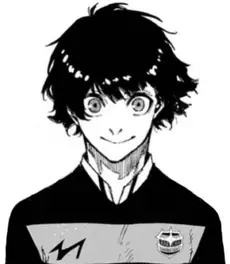
Meguru Bachira also debuts in Chapter 1 and Episode 1, entering Blue Lock from Namikaze High School at age 17 (176 cm / 5’9″, right-footed) and wearing his trademark #8 jersey. Ranked #290 initially before climbing as high as #2 in Chapter 170 and finishing #5 overall in Chapter 298, Bachira is a whimsical, eccentric forward who plays soccer on instinct and creative joy. Bullied during childhood for his unusual personality and exceptional football skill, he invented an imaginary “monster” to serve as his ideal partner—an individuality warmly encouraged by his mother, Yu Bachira. Upon meeting Isagi in Team Z, Bachira recognized a kindred egoist, sparking one of the central friendships and rivalries of the series.
Bachira’s defining weapon is his world-class Elastic Dribbling, which combines sudden changes of direction, close ball control, and creative feints that leave defenders flat-footed. During the Second Selection 4v4 match against Isagi’s Team White, Bachira overcame his childhood trauma and shed his reliance on the imaginary monster, deciding to score for himself and pass only to players who excite him. In the Neo Egoist League, he begins weight training and meditating seriously while joining Spain’s FC Barcha as a starter in Chapter 159 under Master Striker Lavinho, whose energetic, free-spirited style immediately clicks with Bachira’s instincts.
His standout feats include single-handedly breaking past the entire Japan U-20 defense before Shuto Sendou cleared his shot on the goal line, scoring FC Barcha’s opening goal against Bastard München in Chapter 161 (“Bee Shot”) off an assist from Eita Otoya, scoring in every FC Barcha Neo Egoist League match, and securing a ¥120,000,000 bid that ranks him #5 overall. Qualified for the 23-player Japan U-20 squad as a left midfielder (listed among the reserves in Chapter 354’s starting lineup), Bachira’s main weakness is his reliance on rhythm and ball-dominant momentum rather than full-field tactical control when facing highly structured systems.
In Spain’s FC Barcha, Bachira became the creative centerpiece of the attack alongside Eita Otoya, shifting from proactive dribbling to a more mature counteractive style that reads defenders’ movements first before exploding past them. Outside matches, he remains carefree—famously sleeping through the tag test, team meetings, and meals, and walking around naked after training—yet on the pitch, his fusion of Brazilian-inspired ginga flair and his own “Bumblebee” sharpness lets him shift momentum even when FC Barcha is outmatched.
Dribbling and 1v1 Ball Control (Winner: Meguru Bachira)
There is no contest in this category: Meguru Bachira is one of the premier dribblers in all of Blue Lock, whereas dribbling is arguably Isagi’s weakest technical trait. Bachira’s dribbling ability is so advanced that Isagi himself has noted it would be impossible for him to outright steal the ball from Bachira in a one-on-one. Treating the ball as an extension of his body, Bachira deploys Elastic Dribbling alongside an arsenal of named techniques: Hyperspeed Scissors, Marseille Turn, Midair Elastico, Rabona, Double Touch Feint, Aerial Rush Turn, and precise Nutmegs—highlighted by his triple nutmeg in succession on Isagi, Hyoma Chigiri, and Shoei Barou during the Second Selection.
Isagi, by contrast, has spent the entire series compensating for his lack of 1v1 dribbling ability. When he is forced to advance the ball upfield, he relies on quick one-two passes and off-ball sprints with teammates like Ranze Kurona or Yo Hiori rather than beating defenders individually. If Isagi tries to dribble straight through a set defense on his own, he is consistently dispossessed by physically stronger or faster markers.
In a 1v1 scenario, Bachira’s creativity gives him an insurmountable edge. He does not follow rigid, predictable patterns, which means even an analytical defender with Metavision struggles to anticipate his next touch when there is no teammate nearby to help trap him. Bachira’s solo run against the Japan U-20 defense—where he dribbled past the entire backline and goalkeeper before Sendou’s goal-line block—proved that his ball control can slice open organized defenses on its own. Bachira wins this category by a wide margin.
In the Neo Egoist League, where defenders were faster and stronger than anyone in Blue Lock’s earlier selections, Bachira’s dribbling remained his most dangerous weapon. Having already moved past his imaginary monster during the Second Selection, he trained under Lavinho at FC Barcha to mix his dynamic, explosive dribbling with Barcha’s free-flowing style and shift toward counteractive dribbling—waiting to read the defender’s reaction before striking. Isagi himself accepts that he cannot replicate Bachira’s 1v1 flair, choosing instead to build his game around avoiding isolated duels altogether.
Spatial Awareness and Game IQ (Winner: Yoichi Isagi)
While Bachira possesses strong playmaking vision and spots imaginative passing lanes that few others notice, Yoichi Isagi operates on a completely different tactical plane. By unlocking Metavision in Chapter 182 during the Manshine City match—after decoding how Michael Kaiser scanned the field—Isagi sweeps both central and peripheral vision to process massive amounts of spatial data across the pitch simultaneously, tracking player positions, movements, and open lanes in real time.
Isagi’s Egocentrism concept takes his game IQ even further. Instead of reading only physical movement, he analyzes each key player’s motivations and “protagonism”—what they want most in that exact moment—allowing him to predict how both allies and enemies will react before they make a decision. This lets him manipulate the flow of the match, baiting defenders out of position and engineering scoring chances out of chaos.
Bachira’s vision is intuitive rather than analytical. He reads the pitch through rhythm, counteractive feints, and spontaneous link-up play with teammates like Eita Otoya, which keeps him deadly in transition and tight spaces. However, he does not orchestrate full-field tactical traps the way Isagi does. Against Ubers’ structured defensive system featuring Don Lorenzo and Ikki Niko, Isagi’s Metavision allowed him to dissect their coordinated reads and score, whereas Bachira—despite scoring FC Barcha’s lone goal in their 1–3 loss to Ubers—cannot single-handedly out-scheme an entire defensive web. Isagi claims this category decisively.
Shooting and Finishing (Winner: Yoichi Isagi)
Both players are capable of scoring memorable goals against elite goalkeepers, but Isagi’s finishing repertoire is faster to execute and more adaptable inside crowded penalty boxes. His Direct Shot requires zero trapping time, meaning defenders cannot recover once the ball enters his striking zone. Adding a Left-Footed Direct Shot (“Lefty Shoot”) during the Ubers match in Chapter 212 gave him a crucial new angle; even though his left foot initially carried roughly 40% of his right foot’s power and accuracy—forcing him to get deep inside the box—it prevented defenders from shutting down his scoring threat simply by blocking his right side.
The Two-Gun Volley elevates Isagi’s finishing to a higher tier. Unveiled in Chapter 257 (“Two-Gun”) against Paris X Gen, the technique lets Isagi feint a volley with one leg in mid-air to freeze defenders before striking cleanly with the other. It is a finishing weapon built specifically to survive the tightest marking at the highest level of the Neo Egoist League.
Bachira’s shooting is genuinely dangerous, especially after unveiling his Bee Shot against Bastard München in Chapter 161 and scoring against Ubers, Paris X Gen, and a match-winner against Manshine City. Still, Bachira’s goals typically depend on his dribbling or quick wall passes to carve out shooting space first, whereas Isagi can convert half-chances off almost any delivery. When Isagi scored his Two-Gun Volley against Paris X Gen off Kunigami’s header pass while tightly pressured by both Rin Itoshi and Michael Kaiser, he proved his finishing works even when he has zero room to dribble. Isagi takes the win for pure finishing.
Passing and Playmaking (Winner: Tie)
Passing and playmaking is the closest category between these two, because both players excel at elevating teammates through completely different methods. Bachira is a natural creative playmaker who delivers incisive, unexpected passes listed among his core weapons: High Speed Ground Passes with heavy topspin, No-Look Passes executed with a Rabona, Heel Lift Passes to escape a press, Quick Crosses (which he used to assist Rin Itoshi’s goal against Team World Five), and Long-Range Backspin Passes covering nearly 60 meters.
Isagi approaches playmaking like a tactical conductor rather than a soloist. His passes are rarely flashy, but they are timed to trigger “chemical reactions” that force opposing defenses to collapse. Whether he is linking up through Ranze Kurona’s rapid Planet Hotline one-twos or timing combinations with Yo Hiori, Isagi uses passing as a tool to advance into dangerous zones and dictate the tempo of an attack.
Because Bachira’s technical pass variety and improvisation match Isagi’s tactical timing and orchestration, neither player holds a clear advantage here. In Team Z, Bachira assisted both of Isagi’s First Selection goals (against Team Y and Team V) and finished the First Selection with 1 goal and 5 assists, while Isagi posted 2 goals and 3 assists; later at Bastard München, Isagi became the playmaker who assisted Rensuke Kunigami against FC Barcha and Kenyu Yukimiya against Manshine City. This category ends in a well-earned tie.
Off-Ball Movement and Positioning (Winner: Yoichi Isagi)
Off-ball movement is the foundation of Yoichi Isagi’s entire playstyle and a central pillar of his Raumdeuter archetype. Long before unlocking Metavision, Isagi survived in Blue Lock by slipping into defenders’ blind spots and arriving in the penalty area at the exact moment a loose ball or cross dropped. Combined with Metavision and reflex, his off-ball runs become nearly impossible to track as he constantly occupies the highest-value spaces on the pitch.
Bachira’s off-ball movement is sharp during rapid give-and-go sequences, such as darting behind defenders to collect return passes with Eita Otoya or Lavinho. However, Bachira is fundamentally a ball-dominant dribbler who wants the ball at his feet so he can dictate the action directly. He rarely spends extended stretches lurking off the ball waiting for a single decisive touch.
In modern 11v11 football, where an individual player touches the ball for only a small fraction of a match, Isagi’s mastery of the time spent off the ball gives him a massive edge. During the Blue Lock Eleven vs. Japan U-20 match in Chapter 147, after Rin Itoshi blocked Sae’s cross-elastico nutmeg and sent the loose ball looping over Oliver Aiku, Isagi used his philosophy of “luck” to arrive in the exact scoring pocket ahead of Aiku and fire a direct volley past Gen Fukaku without needing a 1v1 dribble. Isagi wins off-ball movement easily.
Physicality and Athleticism (Winner: Meguru Bachira)
Neither Isagi nor Bachira is built like a powerhouse target man such as Shoei Barou or Rensuke Kunigami, and both stand at virtually the same height—175 cm for Isagi and 176 cm for Bachira—but Bachira holds a clear edge in functional athleticism. His agility, balance, coordination, and change-of-direction burst allow him to spin around defenders at top speed, execute midair elasticos, and stay upright under physical challenges without losing his dribble.
Isagi’s physical limitations were glaringly exposed when he first unlocked Metavision against Manshine City: the intense mental and physical workload drained his stamina so severely that he collapsed and passed out for hours right after the final goal. Although Isagi worked steadily to build stronger conditioning and a sturdier physique—eventually developing noticeable muscle by the U-20 World Cup—his pure sprint speed, agility, and body control still lag behind top athletic specialists.
Bachira’s superior agility, balance, and dynamic acceleration—reinforced by the weight training and meditation he adopted during the Neo Egoist League—make him the better athlete of the two. He wins this category cleanly.
This athletic gap is most visible in transition moments. When a counterattack breaks out, Bachira can burst past his marker with a single touch and maintain full speed while weaving through traffic. Isagi, by contrast, relies on anticipating the turnover a second early so he can start his off-ball run before faster defenders react.
Mentality, Ego, and Clutch Factor (Winner: Yoichi Isagi)
Both players possess ferocious egos that allow them to thrive under pressure, but Isagi’s mentality is uniquely suited for mid-match adaptation and late-game heroics. Isagi has a proven habit of shattering his own playstyle mid-match, discarding what no longer works, and reconstructing himself on the fly to overcome stronger rivals. His willingness to devour teammates and opponents alike—and endure the despair of facing natural geniuses as a “talented learner”—makes him a relentless clutch performer.
Bachira’s ego underwent a major transformation during the Second Selection rematch, shifting from a search for someone to play with to a confident, self-reliant desire to become the world’s best striker who scores for himself. In the Neo Egoist League, his carefree joy allows him to play fearlessly even against world-class competition, and he delivered a dramatic late game-winner against Manshine City to give FC Barcha a 3–2 win. However, Bachira’s mindset focuses on maintaining his own rhythm and flow rather than systematically dismantling an opponent’s strategy.
When a match hangs in the balance, Isagi’s Flow state, world-style freedom ego, and adaptability repeatedly produce decisive turning points—from his Chapter 147 winner against Japan U-20 to his Two-Gun Volley and white-haired awakening against Paris X Gen and France U-20, as well as his multi-position tactical breakthrough against England. Isagi takes the final category.
That clutch factor is not mere luck; it comes from Isagi’s willingness to constantly update his mental model of the pitch. Even when an initial plan fails, he treats that failure as data to build a sharper solution on the next possession. Bachira’s joy-driven mentality keeps him dangerous throughout a match, but Isagi’s relentless hunger for self-reconstruction makes him the player opponents fear most in decisive moments.
Scorecard: Isagi vs Bachira
| Category | Winner | Key Reason |
|---|---|---|
| Dribbling and 1v1 Ball Control | Meguru Bachira | Elastic Dribbling repertoire and unmatched 1v1 ball retention |
| Spatial Awareness and Game IQ | Yoichi Isagi | Metavision and Egocentrism enable full-field tactical prediction |
| Shooting and Finishing | Yoichi Isagi | Direct Shot, Lefty Shoot, and Two-Gun Volley under tight marking |
| Passing and Playmaking | Tie | Bachira’s creative pass variety matches Isagi’s tactical orchestration |
| Off-Ball Movement and Positioning | Yoichi Isagi | Raumdeuter blind-spot runs and optimal space occupation |
| Physicality and Athleticism | Meguru Bachira | Superior agility, balance, and dynamic change-of-direction burst |
| Mentality, Ego, and Clutch Factor | Yoichi Isagi | Relentless mid-match adaptation, Flow state, and clutch goals |
Final Tally: Yoichi Isagi wins 4 categories, Meguru Bachira wins 2 categories, and 1 category ends in a tie.
What Happened When Isagi and Bachira Actually Faced Off
Isagi and Bachira spent the First Selection as close partners on Team Z, where Bachira’s dribbling and passing assisted both of Isagi’s First Selection goals—his 2–1 game-winner against Team Y and his 5–4 game-winning Direct Shot against Team V (while Isagi assisted Hyoma Chigiri’s equalizer in the 4–4 draw with Team W). However, the series has pitted them against each other twice in major matches. Their first clash occurred in the Second Selection Fourth Stage 4v4 match, where Isagi, Seishiro Nagi, Shoei Barou, and Hyoma Chigiri (Team White) faced Rin Itoshi, Jyubei Aryu, Aoshi Tokimitsu, and Bachira (Team Red). During that match, Bachira’s attachment to Isagi was tested until he awakened his egoistical style—pulling off a triple nutmeg on Isagi, Chigiri, and Barou—before Isagi blocked Bachira’s final shot attempt, only for the loose ball to fall to Rin Itoshi for Team Red’s 5–4 victory.
That Second Selection 4v4 match was a turning point for both characters. For Bachira, it meant realizing he did not need Isagi or an imaginary monster to validate his soccer, freeing him to dribble for his own sake. For Isagi, reading and blocking Bachira’s final solo rush proved that his spatial awareness could anticipate even an unpredictable dribbler when a match hung by a thread—even though Rin’s follow-up still won the game.
Their second and most important head-to-head meeting took place in the opening match of the Neo Egoist League between Bastard München and FC Barcha, spanning Chapters 159 to 167 under the league’s first-to-three-goals format. Bachira started the match for FC Barcha and immediately showcased his Spanish evolution, teaming up with Eita Otoya to score Barcha’s opening goal in Chapter 161 (“Bee Shot”) with his ginga-inspired footwork. Isagi, meanwhile, began the match on the bench and was subbed on for Erik Gesner in Chapter 163 (“Embodiment”) after Michael Kaiser equalized at 1–1.
Even though Bastard München won the match 3–2—with goals from Kaiser, Noel Noa, and Rensuke Kunigami against goals from Bachira and Lavinho—Bachira outperformed Isagi individually in that specific game. Isagi was still adapting to Germany’s hyper-rational system and Michael Kaiser’s dominance, finishing with the match-winning assist to Kunigami rather than scoring himself. Later in the Manshine City match, decoding Kaiser’s Metavision sparked Isagi’s own exponential climb, eventually propelling Isagi far ahead of Bachira in the final ¥240,000,000 vs. ¥120,000,000 rankings.
Looking at their Neo Egoist League trajectories side by side highlights how differently they grew. Bachira started the tournament at a higher baseline, earning an immediate ¥32,000,000 bid after his performance against Bastard München, and climbed to ¥66,000,000 after Ubers, ¥79,000,000 after Paris X Gen, and finally ¥120,000,000 after leading FC Barcha to a 3–2 victory over Manshine City. Isagi, by contrast, started with a modest ¥17,000,000 bid after FC Barcha, jumped to ¥50,000,000 after Manshine City, surged to ¥150,000,000 after Ubers, and reached ¥240,000,000 after Paris X Gen.
This contrast in bid growth reflects how club scouts value different archetypes. Bachira’s consistent, creative production as FC Barcha’s focal point made him a high-value winger and locked in his top-five finish. Isagi’s explosive spike came from proving he could dismantle organized tactical systems, score consistently in clutch moments, and rival New Generation World XI talent like Michael Kaiser, which is why his final valuation doubled Bachira’s.
Related Guides
Frequently Asked Questions
Who would win in a 1v1 between Isagi and Bachira?
Meguru Bachira would win a pure 1v1 match almost every time. Isagi’s greatest weapons—Metavision, off-ball runs, and Direct Shot—rely heavily on having teammates to combine with and defenders to manipulate, and Isagi himself has admitted he cannot outright steal the ball from Bachira in a one-on-one. Without teammates, Bachira’s Elastic Dribbling and agility would overwhelm Isagi’s average 1v1 defending.
Why is Isagi’s Neo Egoist League bid higher than Bachira’s?
Isagi finished the Neo Egoist League with a ¥240,000,000 bid (tied for #1 with Rin Itoshi) compared to Bachira’s ¥120,000,000 (#5) because Isagi proved he can command an entire offense and win against the league’s toughest systems. While Bachira was a brilliant creative engine for FC Barcha, Isagi consistently delivered decisive goals, broke down defenses like Ubers, and outplayed Michael Kaiser for control of Bastard München.
Did Bachira beat Isagi in the Neo Egoist League?
Individually, Bachira had the stronger start when FC Barcha faced Bastard München in Chapters 159–167, scoring Barcha’s opening goal off Eita Otoya’s assist in Chapter 161 and assisting Lavinho while Isagi began on the bench and finished with one assist after replacing Erik Gesner in Chapter 163. However, Bastard München won the match 3–2, and Isagi’s subsequent growth with Metavision, his Lefty Shoot, and the Two-Gun Volley pushed him well past Bachira by the end of the league.
Who is better between Isagi and Nagi?
In the isagi vs nagi debate, Isagi is the far more consistent and complete player by the end of the Neo Egoist League. While Seishiro Nagi possesses extraordinary trapping talent and scored a miraculous five-stage revolver fake volley against Bastard München to earn an ¥88,000,000 opening bid, his lack of self-sustaining ego caused his bids to drop through ¥43,000,000 and ¥40,000,000 down to ¥24,000,000 (24th place, missing the top-23 cutoff), whereas Isagi rose to the #1 rank.
How does Isagi compare to Ashito Aoi from Ao Ashi?
Fans often search for ashito vs isagi because both protagonists rely on elite spatial awareness rather than raw athleticism. Ashito Aoi is a playmaking left fullback for Tokyo Esperion who uses his vision to orchestrate play from defense, while Yoichi Isagi is a forward and offensive midfielder who uses Metavision primarily to create and finish goals in the final third—though Isagi has also demonstrated defender-midfielder-forward versatility in the U-20 World Cup.
Can Isagi and Bachira still play well together on the Japan U-20 team?
Yes, their styles complement each other even better now than in their Team Z days. Both earned spots on the 23-player Japan U-20 squad for the PIFA U-20 World Cup—with Isagi serving as a regular starter and Bachira contributing as a dynamic left midfielder (even when rotated into the reserves for Chapter 354’s starting XI against England). Bachira’s ability to draw multiple defenders with his dribbling creates prime pockets of space for Isagi’s Metavision off-ball runs, letting them trade playmaking and finishing roles whenever they share the pitch.
Final Verdict
If you put Yoichi Isagi and Meguru Bachira on an empty street court for a 1v1, Bachira will embarrass Isagi with his dribbling and take the win. On a full 11v11 pitch, however, Isagi is the superior player and the clear winner of the isagi vs bachira debate. His Metavision, off-ball movement, and Two-Gun Volley allow him to dictate the entire match and deliver goals when it matters most, proving why he holds the #1 bid alongside Rin Itoshi and earned the “Otherworldly Cheater” moniker on the U-20 World Cup stage.
At the same time, Bachira’s ¥120,000,000 valuation, #5 overall ranking, and lethal dribbling and passing arsenal show that he remains one of Japan’s most irreplaceable weapons in the PIFA U-20 World Cup. He does not need to beat Isagi at his own tactical game to be world-class. Together, Isagi’s brain and Bachira’s flair form one of the deadliest partnerships in the entire series, even if Isagi holds the crown when they stand on opposite sides.