Between Ao Ashi and Blue Lock, Blue Lock wins on sheer entertainment value, commercial reach, and high-stakes drama, while Ao Ashi wins on tactical realism and character depth. The core difference comes down to how each series handles failure: in Blue Lock, getting blue lock eliminated means your career with the Japanese national team ends on the spot, whereas Ao Ashi treats setbacks as part of a long, realistic climb through youth club football. Choosing the better series depends on whether you want a psychological battle royale on a pitch or an authentic coming-of-age sports drama.
Fighter Profiles: Two Sides of Modern Soccer Manga
Before breaking down individual categories, it helps to look at what each series actually is, how far both have progressed as of late 2026, and what makes their core premises tick. Both series launched in the mid-to-late 2010s and reshaped how sports manga is written, yet they approach the exact same sport from opposite ends of the spectrum.
Ao Ashi

Written and illustrated by Yugo Kobayashi, Ao Ashi ran in Shogakukan’s Weekly Big Comic Spirits from January 2015 until its conclusion on June 23, 2025. The completed manga spans 410 chapters across 40 tankobon volumes, ending with its acclaimed Barcelona arc, and has surpassed 26 million copies in circulation. It won the 65th Shogakukan Manga Award in the General category in 2020. On the anime side, Production I.G animated the 24-episode first season in 2022, and TMS Entertainment took over for Season 2, which premiered on October 4, 2026, for a 24-episode split-cour run following Ashito after his promotion to the Esperion U-18 A-Team as he competes in the U-18 Premier League.
The story follows Ashito Aoi, a raw, hot-headed forward from Ehime Prefecture who possesses extraordinary spatial awareness but lacks formal tactical education. Scouted by Tatsuya Fukuda, manager of Tokyo City Esperion FC Youth, Ashito enters the cutthroat world of Japan’s J-Youth club system. His defining turning point arrives when Fukuda converts him from a striker into a left full-back, forcing him to learn how to orchestrate the entire pitch rather than chase personal glory. Ao Ashi’s greatest strength is its commitment to real-world football mechanics, off-the-ball movement, and the emotional weight of teenagers trying to earn professional contracts. Its main weakness is a slower early pace that demands patience from readers who expect instant fireworks.
Beyond the main series, Yugo Kobayashi also wrote the spinoff manga Ao Ashi: Brotherfoot, which focuses on Ashito’s older brother Shun Aoi and his own football journey in Ehime. Together, the main story and spinoff paint a complete picture of Japanese grassroots and academy football, from local high school pitches to international youth tournaments against European giants.
Blue Lock
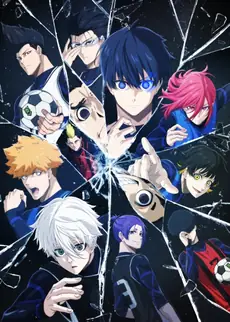
Written by Muneyuki Kaneshiro and illustrated by Yusuke Nomura, Blue Lock began serialization in Kodansha’s Weekly Shonen Magazine in 2018 and remains ongoing, reaching Chapter 370 and 41 collected volumes as of November 2026 (with Volume 42 scheduled for January 2027). The series has surpassed 65 million copies in circulation, won the 45th Kodansha Manga Award in the Shonen category in 2021, and made history in 2023 as the first sports manga to top Oricon’s annual sales chart with over 10.52 million copies sold that year. Studio 8bit animated Season 1 (24 episodes, 2022 to 2023) and Season 2 (14 episodes, 2024, covering the Japan U-20 match), alongside the Episode Nagi spinoff film. Season 3, titled Blue Lock: Neo Egoist League, is officially in production at Studio 8bit as of late 2026, though no premiere date has been announced.
Following Japan’s Round of 16 elimination in the 2018 FIFA World Cup, the Japan Football Union hires eccentric coach Jinpachi Ego to create the world’s greatest egotistical striker. Ego locks 300 high school forwards inside the Blue Lock training facility—a massive pentagon-shaped skyscraper built into a cliffside in the mountains of Japan—where cooperation is secondary to individual survival, and anyone who fails a selection is permanently barred from representing Japan’s national team. Divided into five strata housing living quarters, dining halls, weight rooms, specialty training rooms, multiple practice fields, and a central arena capable of hosting a professional match, the complex enforces a strict daily schedule of machine workouts, tactical sessions, and night team meetings. Protagonist Yoichi Isagi enters ranked 299th out of 300 and must evolve his spatial vision, off-the-ball movement, and “metavision” to devour rivals like Rin Itoshi, Meguru Bachira, and Michael Kaiser. Blue Lock’s strength is relentless pacing, unforgettable character designs, and hype-driven payoffs. Its weakness is that its football logic often bends toward battle-shonen superpowers, leaving defensive structure and realistic team play behind.
The franchise also expanded through Blue Lock: Episode Nagi, a spinoff manga written by Muneyuki Kaneshiro and illustrated by Kota Sannomiya that ran from June 2022 to July 2025, concluding at 36 chapters and 8 volumes. Telling the story from Seishiro Nagi’s perspective alongside Reo Mikage, Episode Nagi gave fans a closer look at how other strata experienced the brutal early selections.
Tactical Realism and Football Accuracy: Ao Ashi Wins
Ao Ashi takes this category without much resistance because Yugo Kobayashi treats football as a 22-player tactical puzzle rather than a series of one-on-one duels. Every match in Ao Ashi is built around real coaching concepts: five-lane attacking theory, pressing traps, inverted full-backs, and how a single player’s positioning changes the geometry of the entire pitch. When Ashito struggles to understand why he was moved to full-back, the manga spends chapters breaking down his field of vision and teaching him how to communicate with center-backs and midfielders.
Blue Lock uses real football terminology, especially in later arcs like the Neo Egoist League, where players join European-inspired clubs such as Bastard Munchen, Manshine City, and PXG. However, its matches frequently devolve into strikers teleporting across the pitch to make goal-line clearances or delivering monologues mid-dribble while defenders stand frozen. That stylistic choice serves Blue Lock’s psychological thriller tone, but readers looking for authentic youth academy football will find Ao Ashi far more rewarding.
In Ao Ashi, even a single tactical adjustment can decide an entire 90-minute match. During the Tokyo Esperion versus Funabashi match, for example, the story breaks down five-lane attacking structure and how physical pressing and disciplined organization can suffocate a technically superior team. Later, against domestic high school powerhouse Aomori Seiran in the Premier League and against FC Barcelona Youth at the Al Kass International Cup, Kobayashi illustrates how elite academies and top high school programs drill positional awareness, rapid decision-making, and coordinated play. Blue Lock rarely lingers on defensive shape because its entire premise is built around breaking structure through individual ego.
Stakes and Elimination Tension: Blue Lock Wins
Nothing in modern sports manga matches the immediate, suffocating pressure of Blue Lock’s elimination system. From the very first chapter, Jinpachi Ego makes the rule clear: if you are blue lock eliminated, your dream of playing for Japan is dead forever. Losing a match does not mean waiting for next season’s tournament; it means packing your bags and walking out of the facility in disgrace.
We see this brutality immediately when Ryosuke Kira, Japan’s supposed “jewel,” is knocked out in a 136-second game of tag in a small room before touching a real pitch. Later, during the Second Selection, Team Z goalkeeper Okuhito Iemon clears the opening 100-goal solo challenge at Rank #101, only to fall short in the small-team stages off-screen and get locked off permanently. Even Rensuke Kunigami, one of the original core cast members, is eliminated after he and Reo Mikage lose a two-on-two match 5-2 against Ryusei Shido and Gurimu Igarashi, only surviving because he enters the secret Wild Card door. Ao Ashi has real-world stakes, such as players being cut from the Esperion academy or missing out on pro promotions, but those stakes unfold over months rather than minutes.
Because Blue Lock’s elimination rules are so unforgiving, every pass and every shot carries existential weight. Characters cannot afford to play safe or defer to a senior teammate, because finishing second in a group or failing to get picked in a draft can end their career. That constant pressure forces players to evolve mid-match, turning every selection into a high-wire act that Ao Ashi’s realistic club schedule simply does not try to replicate.
Character Development and Cast Depth: Ao Ashi Wins
Ao Ashi excels at making every member of Tokyo City Esperion feel like a human being with a life outside the pitch. Characters like Nagisa Akutsu, Haruhisa Kuribayashi, Eisaku Ootomo, and Hana Ichijo carry distinct personal histories, family pressures, and insecurities that shape how they play. Akutsu’s arc, in particular, transforms him from an abrasive bully into one of the most compelling defenders in sports manga by showing the poverty and neglect he endured growing up.
Blue Lock boasts a massive, charismatic cast, and its character designs are instantly iconic. Yet because the premise forces 300 strikers into constant competition, most characters are defined by a single weapon, ego, or trauma. Kunigami’s return from the Wild Card as a cold, ambidextrous machine modeled after Noel Noa is a thrilling plot twist, but it strips away his earlier idealistic personality in favor of pure edge. Ao Ashi gives its cast room to breathe, fail, and mature, earning it the win here.
Supporting figures in Ao Ashi, such as coach Tatsuya Fukuda and medical-minded Hana Ichijo, also carry multi-volume storylines that directly influence Ashito’s growth. Fukuda’s own past in Spain and his career-ending injury explain why he is so obsessed with building a Japanese club capable of competing with European academies. In Blue Lock, adult figures like Jinpachi Ego and Anri Teieri function mostly as mysterious orchestrators rather than fully realized human beings.
Pacing and Hook Factor: Blue Lock Wins
If you hand both manga to a casual reader, Blue Lock will hook them faster. Chapter 1 drops Yoichi Isagi into a dystopian soccer facility, introduces Jinpachi Ego’s outrageous philosophy, and ends with a sudden-death game of tag. Every arc escalates cleanly: the First Selection’s round-robin survival, the Second Selection’s draft-style 2v2 and 3v3 battles, the Japan U-20 match, and the Neo Egoist League’s global club showcase.
Ao Ashi takes a deliberate, grounded approach. Ashito’s tryout in Tokyo, his adjustment to living in the Esperion dorms, and his early struggles on the B-Team take dozens of chapters before he even steps onto the A-Team pitch. That slow burn pays off massively during the Aomori Seiran match and the final Barcelona arc, but Blue Lock’s ability to deliver cliffhangers every single week makes it the clear winner for pure momentum.
Even within single matches, Blue Lock structures its chapters like a battle shonen tournament. A match against Team V or the Japan U-20 squad features constant momentum swings, sudden awakenings, and last-second goal-line drama. Ao Ashi’s matches unfold at a steadier, more realistic rhythm, where several chapters might pass without a single goal as both teams probe for tactical weaknesses.
Artwork and Visual Storytelling: Tie (Edge to Blue Lock for Hype)
Both manga feature outstanding art, though they aim for completely different effects. Yusuke Nomura’s artwork in Blue Lock is explosive, jagged, and theatrical. When Isagi activates metavision or Barou Shoei unleashes his predator eye, the panels crackle with dark aura, shattered puzzle pieces, and exaggerated expressions that make a routine shot on goal feel like a final boss battle.
Yugo Kobayashi’s art in Ao Ashi is cleaner, more grounded, and remarkably precise when depicting body language and spatial positioning. Kobayashi uses wide-angle overhead panels to show all 22 players moving in sync, letting readers actually see the passing lanes Ashito spots before he makes a run. Because Blue Lock’s visual peaks generate viral moments while Ao Ashi’s panels teach you how to read the game, this category ends in a narrow edge for Blue Lock’s sheer spectacle, though both are top-tier.
The contrast is clearest in how each artist draws exhaustion and intensity. Nomura leans into ink-heavy shadows, glowing eyes, and surreal visual metaphors like chains, monsters, and puzzle pieces. Kobayashi relies on subtle facial expressions, sweat, and posture shifts to show a defender losing half a step late in a grueling match.
Anime Adaptation Quality: Ao Ashi Wins
As of late 2026, Ao Ashi holds the advantage in overall anime consistency. Production I.G delivered a solid, faithful 24-episode first season in 2022 that captured Ashito’s growth without cutting major tactical explanations. When Season 2 premiered in October 2026 under TMS Entertainment, the production maintained strong character acting and smooth match choreography for the U-18 Premier League arc.
Blue Lock’s anime adaptation has been a rollercoaster. Season 1 had striking visual direction and memorable voice acting, though its CGI and still frames drew criticism during heavy action sequences. Season 2’s 14-episode run covering the Japan U-20 match suffered from noticeable animation shortcuts and slideshow-like stretches before pulling together a strong finale. Until Season 3 (Neo Egoist League) proves Studio 8bit can sustain high-end animation across a full cour, Ao Ashi takes the anime category.
For international viewers, both series are easy to stream on Crunchyroll with subtitles and English dubs. However, Ao Ashi’s Season 2 under TMS Entertainment has given fans a much more reliable weekly viewing experience in late 2026 than Blue Lock’s troubled sophomore season did in 2024.
Cultural Impact and Commercial Reach: Blue Lock Wins
Blue Lock is a global juggernaut. With over 65 million copies in circulation, an Oricon #1 annual finish in 2023, and massive crossover appeal among non-sports fans, it sits alongside Haikyu!! and Slam Dunk in commercial reach. Its “egoist” catchphrases, character popularity polls, and high-energy collaborations turned it into a mainstream phenomenon.
Ao Ashi is deeply respected by football fans, coaches, and seinen readers, and its 26 million copies in circulation alongside a Shogakukan Manga Award represent huge success by any normal standard. Furthermore, finishing its 410-chapter run in June 2025 gave it a complete, cohesive legacy. Still, in terms of sheer global footprint and mainstream cultural dominance, Blue Lock wins comfortably.
Blue Lock’s influence also extends into real-world football culture, with professional players and youth fans referencing its egoist philosophy on social media. Ao Ashi’s influence is quieter but just as meaningful, earning praise from J-League players and coaches for accurately portraying the sacrifices required to turn pro.
Ao Ashi vs Blue Lock Scorecard
| Category | Winner | Key Reason |
|---|---|---|
| Tactical Realism | Ao Ashi | Authentic J-Youth coaching, five-lane theory, and full-back playmaking |
| Stakes and Elimination Tension | Blue Lock | Permanent national team bans and brutal Wild Card survival |
| Character Development | Ao Ashi | Deeply human side cast with grounded personal and family arcs |
| Pacing and Hook Factor | Blue Lock | Immediate battle-royale premise and relentless weekly cliffhangers |
| Artwork and Visuals | Blue Lock (Edge) | Explosive aura-driven panels vs Ao Ashi’s tactical wide-angle clarity |
| Anime Adaptation | Ao Ashi | Consistent production across Production I.G and TMS Entertainment |
| Commercial Reach | Blue Lock | 65M+ copies in circulation and #1 Oricon annual finish in 2023 |
What Happens When Their Philosophies Collide
Ao Ashi and Blue Lock have never had an official crossover chapter, so they never meet inside a shared fictional match. However, comparing how both stories handle the exact same football dilemma shows why fans constantly pit them against each other. In Blue Lock, Jinpachi Ego argues that Japan fails at the World Cup because its players are too polite, too team-oriented, and lack a ruthless striker who demands the ball at all costs. Every system in Blue Lock is engineered to manufacture that ego.
Ao Ashi’s Tatsuya Fukuda agrees that Japanese football lags behind Europe, but he diagnoses the exact opposite problem. Fukuda believes Japanese youth players lack tactical intelligence, communication, and the ability to read space as a collective unit. When Ashito Aoi is stripped of his striker role and moved to left full-back, he experiences his own version of ego death, realizing that controlling the entire pitch from defense is more powerful than chasing individual goals. In short, Blue Lock asks what happens when you weaponize selfishness, while Ao Ashi asks what happens when you weaponize understanding.
The clearest parallel between the two protagonists lies in their signature abilities. Ashito Aoi’s “bird’s-eye view” and Yoichi Isagi’s “metavision” both allow them to process the entire pitch in real time and predict where the ball will land next. Yet Isagi uses that vision to position himself as the lone executioner who scores the final goal, whereas Ashito uses it to link his defense, midfield, and attack into a single unstoppable organism. Putting them on the same pitch would be a clash of pure philosophy: one player trying to devour the system, and the other trying to become the system.
Related Guides
Frequently Asked Questions
What does it mean to be blue lock eliminated?
Being blue lock eliminated means a player has failed one of Jinpachi Ego’s selection stages and is permanently barred from ever representing the Japanese national team. Unlike standard school tournaments where you can try again next year, elimination in Blue Lock ends your international career on the spot. Players who lose are locked out of the facility and sent home.
What happened to Kunigami in Blue Lock after his elimination?
Rensuke Kunigami was eliminated during the Second Selection after he and Reo Mikage lost a two-on-two match 5-2 against Ryusei Shido and Gurimu Igarashi (Igaguri), who chose Reo to advance. Instead of leaving the facility, Kunigami walked through a mysterious “Wild Card” door, which turned out to be a brutal physical program designed to replicate Noel Noa’s physique and ambidexterity. Kunigami emerged as the sole survivor of the Wild Card and returned in the Neo Egoist League playing for Bastard Munchen, though the ordeal stripped away his cheerful hero persona.
How was Okuhito Iemon eliminated from Blue Lock?
Okuhito Iemon, who selflessly played goalkeeper for Team Z throughout the First Selection so his teammates could score, survived the initial round-robin stage and cleared the Second Selection’s opening 100-goal solo challenge at Rank #101. However, he failed to advance through the subsequent small-team stages of the Second Selection, and his elimination off-screen was confirmed in Chapter 94.
Is Ao Ashi finished, and how does it compare to Blue Lock’s length?
Yes, the main Ao Ashi manga officially concluded on June 23, 2025, finishing with 410 chapters and 40 volumes, including the final Barcelona arc. Blue Lock remains ongoing in Weekly Shonen Magazine, reaching Chapter 370 and 41 volumes as of November 2026 (with Volume 42 scheduled for January 2027). If you want a complete story with a definitive ending, Ao Ashi already has one.
Which anime is better to watch first: Ao Ashi or Blue Lock?
Watch Blue Lock first if you want fast-paced hype, dramatic rivalries, and a battle-royale structure that hooks you in episode one. Watch Ao Ashi first if you actually play or watch football and want an anime that respects real tactics, passing lanes, and team chemistry. Both Season 1 of Ao Ashi and its ongoing Season 2 (which premiered in October 2026) offer a smoother animation experience than Blue Lock’s uneven Season 2.
Can fans of Haikyu!! enjoy both Ao Ashi and Blue Lock?
Yes, though Haikyu!! fans tend to split depending on what they loved most about Karasuno’s journey. Readers who loved Haikyu!! for its grounded team dynamics, coaching lessons, and emotional side-character arcs usually gravitate toward Ao Ashi. Readers who loved Haikyu!! for its intense individual rivalries and hype-inducing match points often click faster with Blue Lock.
How Blue Lock Eliminations Work
Because the phrase “blue lock eliminated” drives so much of the series’ tension, understanding Jinpachi Ego’s selection structure explains why fans stay hooked. Every phase of the Blue Lock project removes players through a different survival mechanic, ensuring no one can coast on reputation alone.
- Entrance Test (Game of Tag): Across the five strata, each of the 25 rooms of 12 players begins with a 136-second game of tag. Whoever is hit by the ball when the clock hits zero is eliminated on the spot, which is how Ryosuke Kira is knocked out in Chapter 1, leaving 25 teams of 11 players.
- First Selection (Round-Robin): In each stratum, five teams ranked V through Z of 11 strikers play a round-robin tournament. Only the top two teams in each stratum advance, plus the single highest-scoring player from each eliminated team.
- Second Selection (Draft Battles): Survivors must score 100 goals against the holographic goalkeeper Blue Lock Man within 90 minutes, then form small teams to compete in 3-on-3 and 4-on-4 matches until a squad reaches five members. Losing a match drops you down a stage and lets the winning team steal one of your teammates, which is how Rensuke Kunigami is knocked into the Wild Card and how Okuhito Iemon is eliminated before reaching the Third Selection.
- The Wild Card: A secret rehabilitation program hidden behind an alternate exit door. Only one eliminated player, Kunigami, survives its grueling physical conditioning to rejoin the Neo Egoist League.
- Neo Egoist League (Salary Cutoff): After defeating the Japan U-20 team, five groups of players are separated into strata based on their chosen country—Germany, Spain, England, Italy, or France—and compete alongside international youth clubs. Club bidders place salary offers on players after each match, and only the top 23 earners make the final U-20 World Cup roster, cutting everyone else from the squad.
Final Verdict
Blue Lock wins the head-to-head matchup 4-to-3 on the scorecard (counting its narrow visual edge), driven by its unmatched elimination tension, addictive pacing, and massive global impact. Every match feels like life or death, and the constant threat of getting eliminated keeps the stakes sky-high from Chapter 1 onward. Yet Ao Ashi is the superior pure football story, offering a complete 410-chapter masterpiece with richer character arcs, authentic tactics, and a steadier anime adaptation. Read Blue Lock for the adrenaline rush, and read Ao Ashi when you want to fall in love with the beautiful game itself.
If you are still undecided, let your mood pick the winner. Start with Blue Lock if you want a high-octane survival thriller that turns every goal into a psychological duel. Start with Ao Ashi if you want a finished, deeply rewarding sports drama that respects every position on the pitch.