Star Trek: Lower Decks Season 3 Episode 7 Ending Explained. Star Trek is an American science-fiction media franchise that Gene Roddenberry created. It began with the 1960s television series. The show quickly became a global pop culture phenomenon. The franchise has been expanded to include television series, movies, video games, novels, comic books, and other media. It is one of the most well-known and highest-grossing media franchises, with an estimated $10.6 billion in revenues.
SYNOPSIS OF Star Trek: Lower Decks
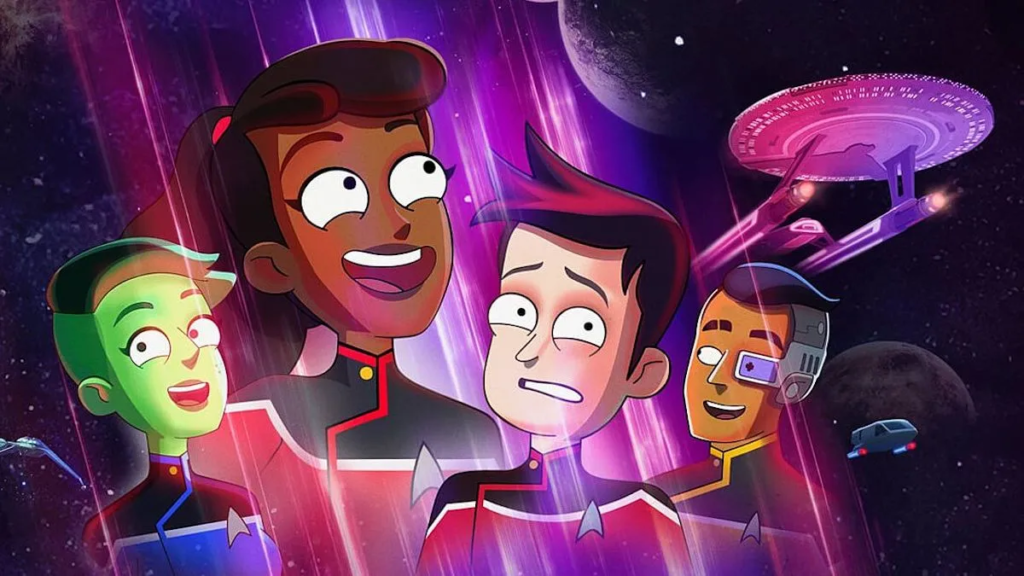
The adventures of the Starfleet crew’s most insignificant vessel. In 2380 aboard the U.S.S. Cerritos, Mariner, Boimler, Rutherford, and Tendi strive to fulfill their duties while continuing their lives, even if they are shaken or affected by many anomalies. Star Trek: Lower Decks Season 3 is one of the best episodes in the series’ history. The show stops focusing on the Cerritos crew and instead follows Peanut Hamper, an unlikely protagonist. Peanut Hamper, a sentient robot who served as a junior officer for the Cerritos and abandoned the crew when they were in dire need, was introduced at the conclusion of Lower Decks Season 1. Peanut Hamper finds herself on a distant planet and must decide whether she wants to be redeemed or continue her dangerously selfish ways.
Star Trek: Lower Decks SEASON 3 EPISODE 7 REVIEW
Peanut Hamper discovers that her benefactor, the village chieftain, is before she is given to the care of the handsome son of the chieftain who is set to inherit his father’s position. After being bitten by a sky snake, the robot saves the chieftain’s life and earns his trust. Peanut Hamper, a basic heat emitter, is able to ensure that all village hatchlings are healthy. This also earns the son’s love, another example of Lower Decks’ hilarious filthy humor. Although the AWOL robot doesn’t like being in a world with straw-based technology, she knows that a distress call could lead to a Federation penal colony. So she reluctantly accepts to be introduced to this new world.
Kaltlorus, the leader, makes progress against the prejudices of the locals against the metal box. She impresses the cute little bird children with duplicated candy but Hamper keeps her toughened shell with her caustic sarcasm about this “backwater planet without a culture” that has never “first contacted.” She meets the charming young Rawda who asks whether a machine is even alive… deep thoughts for a bird man. The young man is reluctantly accepted as the guide of Hamper to Areolus, yes, it is that name.
Star Trek: Lower Decks SEASON 3 EPISODE 7 ENDING EXPLAINED
Peanut Hamper sends distress signals to the Cerritos when the scavengers attempt to wreak havoc in the village using their technology. The crew of the Cerritos decides to investigate. The robot, who has learned Starfleet’s true value, takes down the scavengers as soon as the Cerritos landing party arrives. Captain Carol Freeman agrees that Peanut Hamper will be reinstated into Starfleet in recognition of her heroics in driving back the Scavengers… but this expected redemption story quickly deviates into the darker side of this Star Trek classic. The scavengers activate avian races’ starships, and then use them to attack everyone. Peanut Hamper was the one who alerted them about the ships’ location.
May Also Like: When Will Star Trek: Lower Decks Season 3 Episode 8 Release Date?
The chieftain’s child activates one of his people’s starships in order to save the Cerritos from the scavengers. After this horrendous incident, he declares that his race can live as they please. Peanut Hamper is held in the Daystrom Institute with other sentient robots who are a constant threat to organic life. She considers joining forces with other prisoners to exact revenge on a vicious robot she has previously seen, Beckett Mariner. She becomes frustrated at the lack of artificial intelligence in her new co-workers, who are little more than Star Trek toys. So she stays put in her cell, leaving the galaxy free from her robotic sentence.
THE HISTORY OF FLIGHT
It wasn’t Peanut Hamper’s redemption story. This was her origin story as Star Trek’s latest villain. This episode is a departure from the norm and there is very little character development on our lower decks. This has been a hallmark for Season 3. Each season has ten episodes. This means that each episode is limited to ten episodes. It allowed the episode to explore an alien culture with Areore, which is rare for