The Patient Episode 6 Ending Explained. “The Patient”, created by Joel Fields and Joseph Weisberg, attempts to engage with the true culture of crime by finding its own elegant way into the mind of a killer, while engaging with our thirst to psychoanalyze a disturbed character. The premise of this one wears out, leading to an execution that does a disservice to the plays that can be effective in one man’s quest to get his captor to learn what it’s like to be in someone else’s shoes. “The Patient” is a long journey to create empathy in the darkest of minds, but overall it makes for an excessively long and boring mind game.

Directed partly by FX’s “The Americans” Chris Long, “The Patient” is stuck on how to make this often two-handed setup visually interesting; instead, we dread the basement details more, like the unlocked sliding glass doors that sit ten feet ahead of Alan’s reach. Episode by episode, “The Patient” repeats beats of watching Carell’s face, exhausted, collecting his thoughts, stuck. There are daydreams that take us back to his past, and to his own therapist, tangents that become more interesting than the frantic therapy sessions.
The Patient Episode 6 Review
How does Alan finally try to help his situation?

Things finally seem to take a turn in episode 6 of “The Patient,” as Alan, the therapist, struggles to deal with such an upsetting situation himself, and he seems to come out of it with a glimmer of hope. Picking up the morning after Sam brutally murders Elias right before Alan’s eyes, Episode 6 has a glimmer of Alan trying to shape the narrative and also introduces a new character in a rather unconventional way.
As Sam returns home with the tools to execute his plan to eliminate the corpse, his mother stops him and expresses her displeasure with his recent actions. She says she was about to call the police last night, then advises him not to give up on therapy. This is indeed the response of a mother who learns that her son has killed yet another person, this time in their own home. It is this nonchalance of Candace that always remains disconcerting and also keeps her persona mysterious. With the power tools he bought, Sam now digs a hole in the room where he had held Elias hostage and plans to bury the body there. Alan has been in the same room as the corpse all night, and he is scared of what Sam might do to him next.
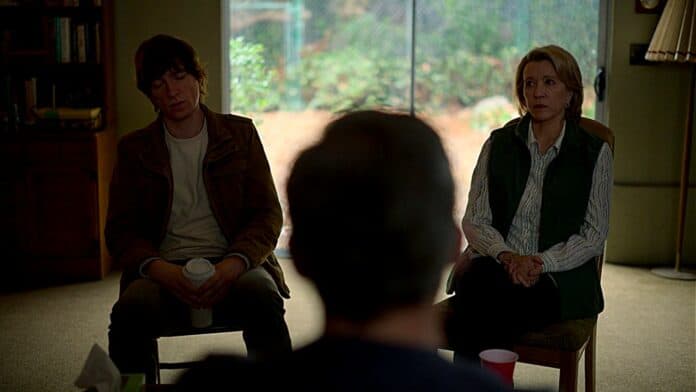
For the first time since being kidnapped and held hostage by Sam, Alan is really struggling to cope and going through a dissociative episode himself. In it, he imagines himself in the office of his now deceased former therapist and mentor and having a conversation with him. This therapist, Charlie, is the one suggesting that Alan needs to think about a way to stay alive through this ordeal. Alan talks about Sam and the issues he is having with his imaginary mentor, and the two seem to believe that Sam still has some sense of empathy in him. As a psychotherapist, Alan has a lot of experience helping his patients, especially with empathy, but he also admits he has never worked with someone as emotionally cold as Sam.
Charlie also suggests that Sam knows that his mother played an indirect role in the pain he suffered as a child, and that analysis (which is actually Alan’s, as he is imagining this whole conversation) seems appropriate. In this imaginary office, Charlie now asks Alan why he hasn’t tried to attack his captor yet, and the man replies that he doesn’t want to be killed before his time is really up. It is then Charlie who convinces Alan that he should and must fight back, that he should try to think of a way to escape Sam’s house alive.

In the current reality, Sam appears rather dangerous as he blames Alan for Elias’ murder he committed the night before. He then treacherously approaches the therapist and tells him that it is his time. While for a brief scary moment it seems like Sam wants to bury Alan alive, what he means by saying it is Alan’s time is that he wants Alan to dig the hole to bury Elias. The chains attached to the floor are loosened and Alan is allowed into the next room, where he is again chained and given a shovel. As Alan digs in the ground, he has flashes of his own son, of seeing anti-Semitic posters in Ezra’s middle school and even concentration camps.
Later that night, as Sam sits down with Alan for another session, the therapist takes a chance on trying to get his way out of the situation. He tries to convince Sam that he shouldn’t bury Elias’ body inside the house but rather dump it somewhere where it could be found by the police, just like his earlier victims. When Sam worries that his address cannot be found because he had brought Elias home, unlike the others, Alan convinces him that modern technologies like DNA analysis would not find him since Sam does not have a criminal record.
In a tense moment, Alan tells Sam to remove the blindfolds from Elias’ body and look at him, to acknowledge Elias as a human being and not just someone who disrespected Sam. However, when this method of getting Sam to develop empathy does not work, Alan tries another way, saying that Elias’ family deserved to know that their son was dead. He explains the entire process of mourning his death in the Jewish religion and finally manages to convince Sam to throw the body somewhere where it could be found. However, before doing so, Sam has to take another one of his bathroom breaks, where he noisily relieves himself, and Alan makes full use of that time.
He quickly retrieves the pen and paper that had been a part of their therapy sessions and scribbles a few words for the police and for his children. Then he pushes this paper into the mouth of the dead Elias, knowing that his note will eventually be found when the body is found by the police. Sam soon comes out and asks if something is wrong with Alan, as he appears puzzled. Alan admits he has a hard time keeping up with so many terrible things happening around him and also thanks Sam for asking. In his mind he is relieved when Sam drags the corpse out of the house and wraps it in a rag before driving somewhere and dumping it with the note inside.
How does Alan manage to help himself?
After the first 5 episodes of “The Patient,” you could say Alan has done too well as a man held captive in the home of a psychopathic patient. It also seems to fit the way Alan is as a person – calm and controlled even in the face of disaster, yet easy to give up. The reason he hadn’t tried to physically fight Sam was that he was always sure he would lose. Alan tells Elias and his imagination of Charlie after they both ask. However, it is also true that Alan was confident in his therapeutic abilities, convinced that he would be able to help himself and Sam by talking to him.
This belief and his trust in Sam is shattered when the young man strangles Elias to death right in front of him, and Alan is now desperate to help himself. It’s not that the thought of hurting Sam for his own security hadn’t occurred to him, because Alan had thought of hitting things on his captor’s head before, and even now, during his conversation with Charlie, a ceramic jug makes its way into this space. This space, which is imagined by Alan’s mind, only has things that are present in the conscious or the unconscious of man, and it is through this jug that Charlie begins to talk about the way Alan should help himself. When Alan finally makes the decision at the end of the episode, it is unclear if he is doing it just to try to escape.
In any case, he seems very sincere and honest when he convinces Sam to let Elias’ parents get his body back, which is in line with Alan’s character and his quick but real bond with Elias. However, for the first time in the series, it looks like Alan prioritizes his own safety over everything else. After all, Elias’ corpse becomes a vessel for his secret message to the outside world, asking for help. This gradual change in Alan’s character, and the way he grew out of his desperation, is quite pleasing to watch.
May Also Like : Don’t Worry Darling Ending Explained: What’s Happened?
The Patient Episode 6 Ending Explained
Charlie is back and Alan helps us identify him. He is Alan’s dead therapist. By talking with him in this way, Alan deduces that he is disassociating himself. Among other things, he has no legible family line and was kidnapped with no hope of getting out alive. Charlie notices Alan frequently staring at the pitcher, to which Alan says he wishes to hit Sam with that in mind. But he laments his lack of strength and being on the wrong side of his old age. If Sam doesn’t kill him, his arrhythmia will; he is out of his pills. Or maybe even foot fungus. Charlie warns Alan to see that Candace herself was responsible for Sam’s childhood abuse and to keep that fact in mind in the next session. Sam is back and takes over from Alan. He brought her delicious food – as he does every night – and escorted her out. Elias is still lying there, by the way.
They start having dinner. Just as Sam begins to walk away to mix the cement, Alan sits him down. It offers an alternate possibility of dealing with the body. To do the little human thing, he could leave his body where it could be found. Sam protests the idea, saying Elias could be traced back to him. They argue the same and Alan seems to give explicit ideas about not burying it in the house. “Therapy isn’t like an exorcism. I can’t suck that feeling out of you,” Alan says. To get better, Sam needs to think about Elias’ parents right now; have empathy for his frightened family. They should at least have the chance to cry for him. To stimulate an empathetic response, Alan asks Sam to cut Elias’ blindfolds to make his face visible. Alan’s heart sinks as the tape comes apart. Sam asks why and the therapist is too speechless to say anything for a second. He tries to remind Sam that Elias is human and his parents will miss him. Candace would if Sam was dead.
The chains finally come off Alan’s feet, but not for the end he would have hoped for. Other flashes follow; Ezra, beaming with light in a closed room, and the predatory limbo of nothingness. The chains are back as Sam puts them on a pipe in the room where he is digging. Alan receives the shovel and starts to dig. Sam drives off in his truck as Alan continues to work hard. By doing this menial job, Alan comes to terms with his failures as a father and, to some extent, his shortcomings in understanding himself better. While walking with what appears to be a school colleague, he confesses that he is afraid to go in front of a crowd of students and asks her to take over.
More Read: When Will The Patient Episode 7 Release Date ?