In Dungeons & Dragons 5th Edition, true polymorph is a 9th-level transmutation spell that transforms a creature into another creature, a creature into a nonmagical object, or a nonmagical object into a creature. Available to Bards, Warlocks, and Wizards, it requires concentration for up to 1 hour, after which the transformation lasts until dispelled. Whether you want to turn a level 17 ally into an Adult Gold Dragon or reshape a large boulder into a CR 9 Clay Golem, it is one of the most versatile endgame spells in the game.
What Is True Polymorph in D&D 5e?
True Polymorph sits at the pinnacle of transmutation magic. While the 4th-level Polymorph spell restricts you to beast forms and expires after an hour, True Polymorph removes creature-type limits, creates creatures from inanimate matter, and can last indefinitely if you hold concentration for the full duration. It functions equally well as a long-term party buff, a downtime minion creator, and a single-target shutdown spell.
To cast the spell, you need access to 9th-level spell slots, which means your character must reach level 17 in a full caster class. Three classes have True Polymorph on their base spell lists in both the 2014 and 2024 Player’s Handbook: Bards, Warlocks (via the 9th-level Mystic Arcanum feature), and Wizards. In addition, an Arcana Domain Cleric from the Sword Coast Adventurer’s Guide can select True Polymorph at level 17 using the Arcane Mastery feature. Sorcerers, Druids, and other Cleric domains do not gain it on their spell lists without multiclassing or magic items such as spell scrolls.
| Spell Attribute | Official 5e Rules Value |
|---|---|
| Level & School | 9th-level Transmutation |
| Casting Time | 1 action |
| Range | 30 feet |
| Components | V, S, M (a drop of mercury, a dollop of gum arabic, and a wisp of smoke) |
| Duration | Concentration, up to 1 hour (until dispelled if concentrated for the full duration) |
| Classes | Bard, Warlock, Wizard (plus Arcana Domain Cleric at 17th level) |
The spell targets one creature or nonmagical object that you can see within 30 feet. If you target an object, it must be neither worn nor carried by another creature. Under the 2014 rules, True Polymorph has no effect on a shapechanger or a creature with 0 hit points, whereas the 2024 Player’s Handbook removed the 0 hit points restriction so downed creatures can be targeted. An unwilling creature can make a Wisdom saving throw against your spell save DC, and on a success it is not affected by the spell.
The Three Transformation Modes Explained
Unlike simpler transformation spells, True Polymorph gives you three distinct ways to alter a target. Each mode follows its own Challenge Rating limits, size rules, hit point mechanics, and behavioral restrictions.
Creature into Creature
This is the most common way players use True Polymorph in combat and downtime. You choose a creature within range and transform it into another kind of creature whose Challenge Rating (CR) is equal to or less than the target’s original CR. If the target has no Challenge Rating, such as a player character, you use the target’s character level as the ceiling instead.
For example, a level 20 Fighter can become a CR 20 Pit Fiend or a CR 17 Adult Gold Dragon, while a level 17 Wizard cannot transform into a CR 20 Ancient Brass Dragon because 20 exceeds 17. You choose a kind of creature rather than a unique named individual with custom statistics, and the target’s game statistics, including its Intelligence, Wisdom, and Charisma scores, are replaced by the new form’s stat block while it retains its alignment and personality.
The target’s gear melds into the new form, meaning the creature cannot activate, use, wield, or otherwise benefit from any of its equipment while transformed. Under the 2014 rules, the creature can still speak, cast spells, or take actions requiring hands if the new form’s anatomy allows it. Under the 2024 Player’s Handbook, the Creature into Creature text states that the target is limited in the actions it can perform by the anatomy of its new form and cannot speak or cast spells.
If your character relies on magic items such as rings, amulets, or staves, you must drop them before being transformed and pick them back up afterward. Whether those items fit or function depends on the anatomy of your new form and the resizing rules in the Dungeon Master’s Guide.
Object into Creature
You can turn a nonmagical object into any kind of creature, provided the creature’s size is no larger than the object’s size and its Challenge Rating is 9 or lower. Size matching is a strict requirement in both the 2014 and 2024 rules: to create a Large Clay Golem (CR 9) or a Large Young Bronze Dragon (CR 8), you must start with a Large or larger object such as a massive stone block, a wagon, or a towering statue. A Tiny pebble can only become a Tiny creature.
While you maintain concentration during the first hour, the newly formed creature is friendly to you and your companions. In the 2014 Player’s Handbook, it acts on each of your turns and you decide what action it takes and how it moves (the SRD states it acts on its own initiative count, and the 2024 PHB states it takes its turns immediately after yours and obeys your commands). Commanding it does not cost a bonus action.
If you concentrate for the full hour and the transformation becomes permanent, you lose automatic control over the creature. From that point on, it acts according to its own nature and alignment, though it might remain friendly to you depending on how you treated it during the first hour. This makes lawful, good, or unaligned creatures far safer long-term creations than chaotic or evil monsters.
Creature into Object
You can turn a creature, along with everything it is wearing and carrying, into a nonmagical object. Under the 2024 rules, the object’s size cannot exceed the creature’s original size, preventing a caster from turning a Medium bandit into a Gargantuan fortress. An unwilling target gets a Wisdom saving throw to resist the transformation.
While in object form, the target’s statistics become those of the object, and the creature has no memory of time spent in this form after the spell ends and it returns to its normal form. Its gear melds into the object and cannot be used or accessed independently while the spell persists.
This mode works as a devastating single-target control option against enemies with weak Wisdom saving throws. If the spell ends before the hour expires, is dispelled later, or the object drops to 0 hit points, the creature reverts to its original form. Under the 2014 rules, it returns with the hit points it had before transforming, and any excess damage past the object’s 0 hit points carries over to reduce its normal hit points.
How True Polymorph Permanent Duration Works
The line “the transformation becomes permanent” in the original 2014 printing of the Player’s Handbook sparked years of debate over whether the magic could ever be undone. Official errata updated that sentence to read “until dispelled,” and the Sage Advice Compendium confirmed that permanent spell effects remain subject to Dispel Magic unless the spell description explicitly states otherwise.
Even after you maintain concentration for the full 60 minutes and drop concentration, an active 9th-level transmutation spell remains on the target. That ongoing magical status carries three major gameplay consequences:
- Dispel Magic can end it: An enemy caster using a 9th-level slot ends True Polymorph automatically. A lower-level casting of Dispel Magic requires a spellcasting ability check against DC 19 (10 plus the spell’s 9th level).
- Antimagic Field suppresses it: If a permanently polymorphed creature enters an Antimagic Field, the spell is suppressed while the creature remains inside. It temporarily reverts to its original form and snaps back into its transformed shape upon leaving the field.
- Reaching 0 Hit Points still reverts it: Concentrating for an hour removes the 1-hour time limit, not the hit point trigger. Dropping to 0 hit points or dying still ends the transformation.
When a permanent True Polymorph ends cleanly through Dispel Magic under the 2014 rules, the target returns to the exact hit points it had before the spell was cast. Damage sustained while polymorphed does not transfer on a clean dispel, though excess damage from dropping to 0 hit points in the transformed form still carries over to the original hit point pool.
2014 vs. 2024 Player’s Handbook Rules Changes
The 2024 Player’s Handbook (page 335) kept True Polymorph as a 9th-level transmutation spell for Bards, Warlocks, and Wizards with the same 1 action casting time, 30-foot range, and material components, while overhauling how Creature into Creature handles hit points and actions.
Under the 2014 rules, transforming a creature into another creature replaced its hit point pool with the new form’s hit points. Under the 2024 rules, the target instead gains Temporary Hit Points equal to the new form’s hit points. Official 2024 PHB errata added the explicit rule under Creature into Creature: “These Temporary Hit Points vanish if any remain when the spell ends.” This closed the loophole where players could gain hundreds of Temporary Hit Points from a high-CR monster and immediately drop concentration to keep the buffer on their regular character.
Two additional 2024 changes matter at the table. First, the 2024 text removed the clause forbidding you from targeting a creature at 0 hit points. Second, the 2024 Creature into Creature rules state that the target cannot speak or cast spells while transformed, curbing combinations that relied on taking a monster form solely for its innate spellcasting or full caster progression.
The Wand of True Polymorph Myth
Many players search for a Wand of True Polymorph after hearing about it in community modules, podcasts, or campaign recaps. In official D&D 5e sourcebooks, there is no official magic item called a Wand of True Polymorph. The closest official item in the Dungeon Master’s Guide (page 209) is the Wand of Polymorph, a Very Rare item requiring attunement by a spellcaster that holds 7 charges and casts the 4th-level Polymorph spell at Save DC 15.
The famous Wand of True Polymorph comes from the popular community one-shot adventure The Wild Sheep Chase by Winghorn Press. In that adventure, the eccentric wizard Finethir Shinebright is turned into a sheep by his former apprentice Ahmed Noke, who stole and recklessly modified the wand. Noke’s unstable version holds 1d4-1 charges (minimum 1) that reset at dawn, can be recognized as unreliable with a DC 15 Intelligence (Arcana) check, and requires a DC 17 Intelligence (Arcana) check each time a charge is spent, increasing the DC by 1 after each success.
Failure carries severe penalties in the module: missing the DC by 5 or less misfires and turns the target into a Gibbering Mouther, while failing by more than 5 also detonates the wand for 1d12 force damage per remaining charge to every creature within 10 feet and destroys the item. Because an unrestricted wand of a 9th-level spell would unbalance a standard campaign, it remains strictly homebrew or adventure-specific.
Best True Polymorph 5e Forms (CR 9 to CR 21)
Choosing the right form depends on whether you are creating a permanent guardian from a Large object (CR 9 or lower), transforming a level 17 to 20 party member (CR 16 to CR 20), or evaluating CR 21+ creatures already on the battlefield. Below are six iconic D&D forms that illustrate the spell’s peak options and limits across those tiers.
Adult Gold Dragon

Known in Forgotten Realms lore by the formal classification Draco Orientalus Sino Dux, gold dragons are the strongest and most majestic of the metallic dragons, serving Bahamut as relentless foes of evil and injustice with lifespans reaching 4,400 years. Their broad, sail-like wings extend from shoulder to tail and ripple in flight like swimming, while their short faces bear sweeping metallic horns, neck frills, and four pairs of flexible barbels. In 5e, an Adult Gold Dragon is a CR 17 (18,000 XP) Huge lawful good dragon, making it available the moment a caster hits level 17. It brings Armor Class 19 from natural armor, 256 hit points (19d12 + 133) in the 2014 Monster Manual (updated to 243 hit points in the 2024 Monster Manual), a 40-foot walking and swimming speed, an 80-foot flying speed, blindsight out to 60 feet, darkvision out to 120 feet, immunity to fire damage, and the Amphibious trait allowing it to breathe both air and water.
For a polymorphed character, the Adult Gold Dragon combines immense durability with unmatched utility. It carries a +13 bonus on Constitution saving throws (alongside Dexterity +8, Wisdom +8, and Charisma +13), which helps a self-polymorphed caster maintain concentration for the full hour, plus Legendary Resistance (3/Day) to shrug off disabling enemy effects. Its breath weapons recharge on a 5 or 6 and offer two 60-foot cones: Fire Breath dealing 66 (12d10) fire damage on a failed DC 21 Dexterity save (half on a success), and Weakening Breath imposing disadvantage on Strength-based weapon attacks, Strength checks, and Strength saving throws for 1 minute on a failed DC 21 Constitution save. Just as valuable outside battle, its Change Shape action lets it assume a humanoid or beast disguise while keeping its dragon statistics (other than size, and without Breath Weapons, Frightful Presence, Tail Attack, or Wing Attack), reflecting the Forgotten Realms tradition of gold dragons walking among communities in unassuming forms, speaking Common and Draconic, and guarding stone lairs filled with crafted art and magic items. Under the 2014 Monster Manual errata, assuming this form via True Polymorph does not grant its Legendary Actions, whereas the 2024 rules removed that limiting line, leaving Legendary Actions up to DM adjudication.
Pit Fiend

At the top of the non-unique baatezu nobility in the Nine Hells, pit fiends stand 12 feet tall, weigh around 800 pounds, and serve only dukes, duchesses, and archdevils as generals, fortress commanders, and city governors. Forged when worthy gelugons or erinyes endure the Pit of Flame for 1,001 days (or spawned directly from drops of Asmodeus’s blood), they feature red scale armor, massive bat-like wings, prehensile tails, and green-venom fangs. In 5e, a Pit Fiend is a CR 20 (25,000 XP) Large lawful evil fiend (devil) with Armor Class 19, 300 hit points (24d10 + 168), a 30-foot walking speed, a 60-foot flying speed, and truesight out to 120 feet. It is immune to fire and poison damage and the poisoned condition, resistant to cold and to bludgeoning, piercing, and slashing damage from nonmagical attacks that are not silvered, and protected by Magic Resistance for advantage on saving throws against spells and other magical effects.
At level 20, the Pit Fiend delivers the highest sustained melee output among standard Monster Manual transformations. Its Multiattack unleashes four strikes per action (+14 to hit): a Bite for 22 (4d6 + 8) piercing damage, a Claw, a Mace dealing 15 (2d6 + 8) bludgeoning damage plus 21 (6d6) fire damage, and a Tail. Any creature hit by the Bite must make a DC 21 Constitution saving throw or become poisoned, taking 21 (6d6) poison damage at the start of each turn and unable to regain hit points until it succeeds on the save at the end of a turn. Under the 2014 rules, it also retains Charisma-based Innate Spellcasting (save DC 21) with detect magic and fireball at will and hold monster and wall of fire 3/day each, while speaking Celestial, Draconic, Infernal, and telepathy. Because True Polymorph preserves the target’s alignment and personality, a heroic level 20 Paladin or Fighter can wield a Pit Fiend’s stat block without becoming evil.
Planetar

Planetars are mighty angels of the Upper Planes, patrolling Mount Celestia, Bytopia, and the Beastlands as celestial stewards, generals, and servants of good deities such as Deneir, Ilmater, and Selûne (whose seven female Shards bore long blue hair and pearly white skin). Typically 8 to 9 feet tall, 500 pounds, bald, emerald-skinned, and winged with opalescent white feathers, they speak all languages and communicate via telepathy within 100 feet. In 5e, a Planetar is a CR 16 (15,000 XP) Large lawful good celestial with Armor Class 19, 200 hit points (16d10 + 112) in the 2014 Monster Manual (262 hit points in the 2024 edition), a towering 120-foot flying speed, truesight, Magic Resistance, and an Intelligence of 22.
For groups lacking a Cleric or facing fiends, a Planetar solves offense, healing, and investigation in a single stat block. Its Angelic Weapons trait makes its weapon attacks magical and adds 5d8 radiant damage to every hit, turning its traditional two-handed greatsword into a devastating melee option. Four times per day, its Healing Touch action touches another creature to restore 30 (6d8 + 3) hit points and remove any curse, disease, poison, blindness, or deafness, while its Divine Awareness trait lets it automatically know when it hears a lie. Under the 2014 rules, its Charisma-based Innate Spellcasting (save DC 20) provides detect evil and good and self-only invisibility at will, blade barrier, dispel evil and good, flame strike, and raise dead 3/day each, and commune, control weather, and insect plague 1/day each. In Forgotten Realms lore, planetars slain outside their home plane reform there over 40 years, though a polymorphed creature simply reverts when dropped to 0 hit points.
Clay Golem

Clay golems are human-shaped constructs standing 8 feet tall and weighing around 600 pounds, sculpted from heavy clay and traditionally animated by priests with a spirit from the Elemental Plane of Earth or crafted using a manual of clay golems. Emotionless and clumsy, they understand the languages of their creator without being able to speak. In 5e, the Clay Golem sits at CR 9 (5,000 XP) as a Large unaligned construct with Armor Class 14, 133 hit points (14d10 + 56), a 20-foot walking speed, darkvision out to 60 feet, and Strength 20 (+5) alongside Constitution 18 (+4) and Intelligence 3 (-4). Because Object into Creature caps out at CR 9 and requires an object at least as large as the creature, transforming a Large stone statue, heavy cart, or large boulder into a Clay Golem produces one of the toughest permanent guardians available from inanimate matter.
What makes the Clay Golem exceptional in defensive roles is its suite of immunities and traits. It is immune to acid, poison, and psychic damage, as well as bludgeoning, piercing, and slashing damage from nonmagical attacks that are not adamantine, plus charmed, exhaustion, frightened, paralyzed, petrified, and poisoned conditions. It has Magic Resistance, Immutable Form (protecting it from effects that would alter its shape), Magic Weapons, and Acid Absorption, which heals the golem instead of harming it whenever it takes acid damage. In combat, it uses Multiattack for two Slam attacks (+8 to hit, 16 or 2d10 + 5 bludgeoning damage) that force a DC 15 Constitution save or reduce the target’s hit point maximum by the damage taken until removed by greater restoration or other magic, and its Haste action (Recharge 5-6) grants +2 AC, advantage on Dexterity saves, and a bonus-action Slam. Watch out for its Berserk trait: starting a turn with 60 hit points or fewer gives a 1-in-6 chance (rolling a 6 on a d6) of losing control and attacking the nearest creature until destroyed or healed back to full hit points.
Beholder
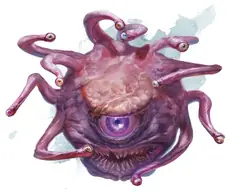
Often called “spheres of many eyes” or “eye tyrants,” beholders are paranoid, hyper-intelligent aberrations of the Underdark measuring 6 to 8 feet in diameter, hovering effortlessly thanks to a lighter-than-air internal gas called tiusium. In Forgotten Realms biology, they possess stony skin, green blood, one lung, two stomachs, a brain with dweomerlobes up to 4 feet wide, and a lifespan of 120 to 150 years, speaking Deep Speech and Undercommon while hoarding magical items to feed their fascination with observing magic. In 5e, a Beholder is a CR 13 (10,000 XP) Large lawful evil aberration with Armor Class 18, 180 hit points (19d10 + 76), a 20-foot flying (hover) speed, immunity to the prone condition, darkvision out to 120 feet, Intelligence 17, Wisdom 15, Charisma 17, and proficiency in Intelligence (+8), Wisdom (+7), and Charisma (+8) saving throws.
A Beholder turns a level 13+ character (such as a spellcaster out of high-level slots) into a floating battlefield controller. Its central eye projects a 150-foot Antimagic Cone functioning like an antimagic field, shutting down enemy casters, magic items, and magical barriers in whatever direction you choose at the start of your turn. Because the cone also suppresses the Beholder’s own eye rays, smart positioning lets you disable a rival spellcaster while blasting targets outside the cone. On its turn, the Eye Rays action fires three random rays (rerolling duplicates) at targets within 120 feet from ten distinct options using DC 16 saves: Charm, Paralyzing, Fear, Slowing, Enervation, Telekinetic, Sleep, Petrification, Disintegration (45 or 10d8 force damage), and Death (55 or 10d10 necrotic damage). In standard monster stat blocks, a Beholder also has 3 Legendary Actions allowing it to fire one random eye ray at the end of another creature’s turn, though polymorphed characters do not gain Legendary Actions under the 2014 Monster Manual errata.
Lich

Known in older lore as lichnees, liches are undead spellcasters, usually wizards (and occasionally sorcerers, warlocks, or clerics), who tether their souls to the Prime Material plane inside a phylactery to gain limitless time for arcane study. Their gaunt, skeletal bodies glow with pinpoints of crimson light in empty eye sockets, project speech magically without lips, speak Common, Abyssal, and languages known in life, and risk degrading into demiliches over centuries. In 5e, a Lich is a CR 21 (33,000 XP) Medium evil undead with Armor Class 17, 135 hit points (18d8 + 54), truesight out to 120 feet, Turn Resistance, Legendary Resistance (3/Day), and immunity to poison and nonmagical bludgeoning, piercing, and slashing damage, as well as charmed, exhaustion, frightened, paralyzed, and poisoned conditions.
With a Challenge Rating of 21, a Lich cannot be chosen as a Creature into Creature form by a standard level 20 player character, because character levels cap at 20 and Epic Boons in the Dungeon Master’s Guide add special features at level 20 rather than raising your level above 20. Accessing a Lich via True Polymorph therefore requires targeting an existing CR 21 or higher creature on the battlefield. Even then, the Lich serves as an important cautionary example for transformation rules: under the 2014 rules it comes with 18th-level Wizard spellcasting (save DC 20, +12 to hit, and slots up to 9th level) plus a Paralyzing Touch (+12 to hit, 10 or 3d6 cold damage, DC 18 Constitution save or paralyzed), whereas the 2024 Creature into Creature text blocks spellcasting entirely. Furthermore, True Polymorph does not grant you a phylactery, so the Lich’s Rejuvenation trait (reforming a new body within 1d10 days, or a tenday in Realms lore, within 5 feet of the phylactery) never triggers; dropping to 0 hit points simply reverts you to your original form.
5e Polymorph List: Best Forms by Challenge Rating
Whether you are transforming an inanimate object (up to CR 9), shifting a companion mid-tier, or maximizing a level 20 hero, having a quick reference by Challenge Rating saves valuable time at the table. Because player characters cap at level 20, the table below covers achievable player and object forms from CR 2 through CR 20, while CR 21+ creatures like the Lich require an already high-CR target.
| Challenge Rating | Creature Name | Type | Primary Role |
|---|---|---|---|
| CR 2 | Giant Elk / Quetzalcoatlus | Beast | High-speed mount or flying transport |
| CR 5 | Unicorn | Celestial | Healing, 1-mile teleportation, and Magic Resistance |
| CR 8 | Young Bronze Dragon | Dragon | Best flying dragon under the CR 9 object cap |
| CR 9 | Clay Golem / Treant | Construct / Plant | Top object-to-creature bodyguards (Large+ object needed) |
| CR 13 | Beholder / Storm Giant | Aberration / Giant | Antimagic control or massive melee damage |
| CR 16 | Planetar | Celestial | Radiant melee damage, 120 ft. fly speed, and healing |
| CR 17 | Adult Gold Dragon | Dragon | Best all-around form for level 17 characters |
| CR 20 | Pit Fiend / Ancient Brass Dragon | Fiend / Dragon | Peak combat power for level 20 characters |
When using Object into Creature, remember that your object must be at least Large to produce a Large Young Bronze Dragon (CR 8) or Clay Golem (CR 9), or Huge to produce a Huge Treant (CR 9). A Large Unicorn (CR 5) is another strong downtime creation: it possesses Magic Resistance, Healing Touch (3/day for 11 or 2d8 + 2 hit points), a once-per-day 1-mile Teleport for itself and up to three allies, and innate spells including pass without trace at will and dispel evil and good once per day.
For Creature into Creature, always check whether the new form can speak and manipulate objects. Gold Dragons, Pit Fiends, and Planetars can all communicate clearly and use hands or claws to interact with doors, levers, and fallen allies, whereas beasts and mindless constructs have severe non-combat limitations.
True Polymorph vs. Polymorph vs. Shapechange
Players often compare D&D 5e’s three signature transformation spells. While their names sound alike, each one serves a distinct tactical role and interacts differently with class features, mental stats, and spell duration.
| Feature | Polymorph (4th Level) | True Polymorph (9th Level) | Shapechange (9th Level) |
|---|---|---|---|
| Target | 1 creature | 1 creature or nonmagical object | Self only |
| Allowed Forms | Beasts only | Any creature (or nonmagical object) | Any creature you have seen (no Constructs or Undead) |
| Mental Stats | Replaced by beast’s stats | Replaced by new form’s stats | You keep your own Int, Wis, and Cha |
| Class Features | Lost | Lost | Retained (if new form is physically capable) |
| Permanent Option | No (1 hour max) | Yes (until dispelled after 1 hour concentration) | No (1 hour max) |
Shapechange is usually superior for a Wizard or Druid who wants to fight as a dragon while keeping full class spellcasting, mental saving throws, and class abilities (and in the 2024 PHB, Shapechange also dropped its explicit ban on using a form’s legendary actions). True Polymorph excels when you want to transform an ally, create a permanent creature from an object, or turn an enemy boss into an inanimate object.
Common Rules Misunderstandings and Exploits
Because True Polymorph overwrites entire stat blocks and can persist indefinitely, it sits at the center of several well-known rules debates. Knowing the official wording prevents mid-session slowdowns.
- Spellcasting in the new form: True Polymorph replaces your class features, including your normal Spellcasting feature, with the new form’s stat block. Under the 2014 rules, you only gain any Innate Spellcasting or Spellcasting trait printed on the creature’s stat block, provided its body can perform the components; under the 2024 rules, Creature into Creature explicitly states the target cannot speak or cast spells.
- The Simulacrum combo: A level 17+ Wizard can create a Simulacrum of themselves and cast True Polymorph on it, turning the duplicate into a creature such as an Adult Gold Dragon for an hour until permanent. Because the underlying 7th-level Simulacrum spell remains active alongside True Polymorph, a Dispel Magic targeting Simulacrum destroys the creature outright, and DMs commonly rule that the simulacrum’s core restrictions (such as being unable to heal normally or regain expended resources, and vanishing if you cast Simulacrum again) continue to apply.
- Magic Jar synergy: Some high-level builds pair the 6th-level Magic Jar spell with True Polymorph to swap into or permanently reshape humanoid bodies while retaining class features. Because stacking multiple long-duration body-replacement spells enters gray rules territory, ask your DM before attempting this combo.
- Legendary Actions: Official 2014 Monster Manual errata explicitly states that if a creature assumes the form of a legendary creature through a spell, it does not gain that form’s legendary actions, lair actions, or regional effects. The 2024 rules omitted that sentence, so check with your DM which standard your table uses.
- Maintaining concentration on yourself: If you cast True Polymorph on yourself, you still make Constitution saving throws to hold concentration whenever you take damage during the first hour. Picking forms with strong Constitution and saving throw bonuses, such as an Adult Gold Dragon (+13 to Constitution saves) or a Pit Fiend with Magic Resistance, greatly improves your odds of reaching the permanent 1-hour mark.
- Equipment and Attunement: Melded gear grants zero passive benefits while you are transformed. If you drop attunement-compatible items like rings, cloaks, or amulets before casting and pick them up afterward, your DM determines whether the items resize to fit your new creature anatomy.
Related Guides
Frequently Asked Questions
What is True Polymorph in D&D 5e?
True Polymorph is a 9th-level transmutation spell on the Bard, Warlock, and Wizard spell lists (and accessible to 17th-level Arcana Domain Clerics). Within 30 feet, it lets you transform one creature into another creature, one creature into a nonmagical object, or one nonmagical object into a creature of CR 9 or lower.
How does True Polymorph become permanent?
If you maintain concentration on True Polymorph for the full 1-hour duration, the spell’s duration changes to “until dispelled” and no longer requires concentration. However, it can still be ended by Dispel Magic (automatically with a 9th-level slot, or with a DC 19 spellcasting ability check), suppressed inside an Antimagic Field, or broken by dropping to 0 hit points.
Is there a Wand of True Polymorph in 5e?
No, there is no official Wand of True Polymorph in any D&D 5e rulebook. The official item in the Dungeon Master’s Guide is the Wand of Polymorph, which holds 7 charges and casts the 4th-level Polymorph spell at DC 15. The unstable Wand of True Polymorph comes from the community one-shot The Wild Sheep Chase, where it carries 1d4-1 charges and risks backfiring into a Gibbering Mouther or exploding.
What is the best True Polymorph 5e form?
For a level 17 character, the Adult Gold Dragon (CR 17) is widely favored for its 256 HP (243 HP in the 2024 rules), 80-foot fly speed, +13 Constitution save, breath weapons, and Change Shape disguise ability. At level 20, the Pit Fiend (CR 20) leads for raw melee damage with 300 HP, Magic Resistance, and four attacks per action. For Object into Creature, a Large or larger object turned into a Clay Golem (CR 9) offers top-tier durability.
Do you keep your class features and spellcasting?
No. True Polymorph replaces your game statistics, class features, and spellcasting with the new creature’s stat block, leaving only your alignment and personality intact. If you want to keep your mental ability scores, class features, and spellcasting while fighting in monster form, cast the 9th-level spell Shapechange instead.
How did the 2024 Player’s Handbook change True Polymorph?
In the 2024 Player’s Handbook, Creature into Creature grants Temporary Hit Points equal to the new form’s hit points rather than a separate hit point pool, and errata states that any remaining Temporary Hit Points vanish when the spell ends. The 2024 version also allows targeting creatures at 0 hit points, caps Creature into Object size at the creature’s size, and states that transformed creatures cannot speak or cast spells.
Final Verdict
True Polymorph remains one of the most rewarding 9th-level spells in Dungeons & Dragons 5e. Across both 2014 and 2024 rulesets, it combines a permanent party buff, a CR 9 creature creator for Large or larger objects, and a single-target shutdown spell in one slot. Track your Challenge Rating and size limits carefully, note your table’s rules on 2024 Temporary Hit Points and Legendary Actions, and remember that “permanent” still means “until dispelled.”