Dire Wolf 5e D&D, it’s late at night and the group is in the forest. They recently murdered a powerful necromancer and are now returning to the town’s safety.
They’re bleeding bloody, bruised and nearly free of items and spells. As they think they’re secure, they hear a roar and a huge wolf appears from the forest. Be proactive!
Direwolves are more massive and danger than regular grey wolves. They pose a risk and shouldn’t be taken lightly. Their strength and size can defeat most adventurers. They’re usually the only one fighting.
What is it that makes this DnD creature so risky? They’re everywhere. How can you stop them? This is the guide for the terrifying wolf!
May Also Like: Serving to Mischief: 5e Imp D&D Guide : Everything You Need To Know
What is a Dire Wolf? Dire Wolf 5e D&D Guide:
An Dire Wolf can be described as an old grey wolf that is bigger than normal wolves. They are approximately 9 feet long and weigh about 800 pounds. They are a bit aggressive and are able to work in pairs or together with up to 3 to 5 other Wolf packs.
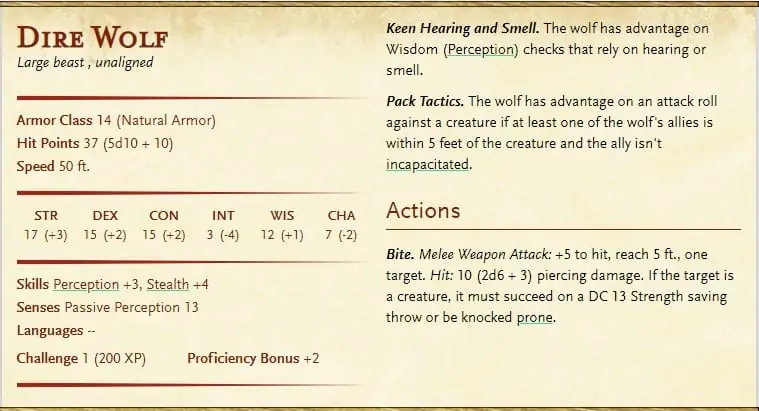
The team has an average AC of 14 37 hitpoints on average fifty feet speed and they have these capabilities.
Keen Smell and Hearing Wisdom (Perception) tests which are based on smell or hearing provide an advantages for the wolf.
Pack strategies. If at the very least one of the wolves’ allies is at least 5 meters from the beast and the ally isn’t incapacitated, the wolf will have an advantage when it comes to making an attack roll to counter it.
Bite. Melee Weapon Attack 5 points to hit. Five feet of reach. One to target. It is hit with (2d6 + 3) Piercing damage. If the creature you are targeting is a creature, it must be able to make an DC 13 Strength saving throw to succeed or fall unconscious.
These rules are broken in order that the wolf will sense or smell someone coming into their area of responsibility. They also have a knack for working in groups and, therefore, if they’re close to an ally and they both target the identical target, they’ll benefit.
The Wolf also has a massive bite attack, which isn’t too risky. However, if they’re trying to bite a creature (and that includes humans) the animal have to roll a 13 on a Strength check. Wolfs gain an advantage on attack rolls in the event of a fall in the event that they slash their victim.
See also: D&D 5e ring of protection Guide : Everything You Need To Know
Dire Wolf Tactics
A group comprised of three to five devil Wolfs will band together to take out the weakest of the pack.
They will approach from the flanks, get close to one another attempt to pull the target with their powerful jaws, and then try to gain the most advantage feasible.
They also have the ability to hit and run by using their speed to split groups before coming back to launch another attack. Also Read: Hexblade 5e D&D Guide
They often can be able to hear or detect the party members well before they’re visible. They will then use their skills of stealth to stealthily approach them to prepare themselves for an ambush.
These wolves are fierce and designed to take out. If you get involved in a fight with them, they’ll likely engage in a fight that will last until the final.
This is different from other wolves who be territorial and only fight or hunt. They’ll flee when they’re injured or their prey is removed from the region.
They also are extremely vulnerable to bleeding and gore, as regular wolves. Dire wolves are known to become aggressive if your team is injured or bloody during a battle.
See also: Pass Without Trace 5e D&D Guide: Everything You Need To Know
Every wolf understands that blood signifies that the subject has been wounded or has a weak constitution. The weakness means they could be eaten, which makes it much easier to bring them down.
Fighting Wolves In A Pack Dire Wolf 5e D&D Guide:
Even though dire wolves feel more at ease working on their own rather than as part of the pack, they could have alpha gained them to reach the highest point of any pack.
They may also battle groups of less powerful Wolves and this causes the Wolves to change their tactics.
Wolf packs always move and are always trying to break up groups to reach the weakest of the group.
They then will run towards the attacker and then bite them. If they are successful in bites, normal wolves will place themselves in the vicinity of the attacker to enable others wolves to take advantage of the pack’s tactics. If they succeed, the Dire Wolf will be exactly the same way.
The real-world wolves are aware how to hunt their prey and keep out of the way. Instead, they chase their prey and then run toward them, trying to convince the group to follow them.
See also: What is Chaos Bolt DnD 5e Spell & Damage ?
After eating a couple of bites after eating a few bites, it’s time for the real fight. The wolves will gather into greater numbers and will make a circle around the party, and others rush to take on those who are weakest in the group.
They fight in pairs and attempt to get an edge over each other.
The process will usually continue until the group is defeated, or around 25% to 50% of the group has been killed or injured. They’ll flee when they are injured.
What can you do to fight the bad Wolf? Dire Wolf 5e D&D Guide
Your players need to be able to take on wild animals, whether they are as part of their pack or the leader of one.
Their strategies of hitting and running could cause frustration for those who play melee. Also Read: 5e Point Buy D&D Guide
The best thing that a heavily armored melee fighter can do is back upand create an enclosure around their weakest members , so that the wolves need to traverse them prior to attacking their enemies.
Due to their lack of the most powerful AC, magic-casting characters can be easily targeted by terrible predators.
See also: True Polymorph 5e : D&D Spell Guide
A few AoE spells can limit the damage that is done to the majority members of the group. This technique works so long as the bad beasts don’t try to attack them and then slam them down with their deadly bite.
They Dire Wolves are immune to any kind of damage. They can be hit with anything, and they’ll take the full amount of damage.
Certain DM’s exploit the animal’s fear of fire. They make wolves use an action of saving or panic when they come across fire spells.
Variants of Dire Wolves
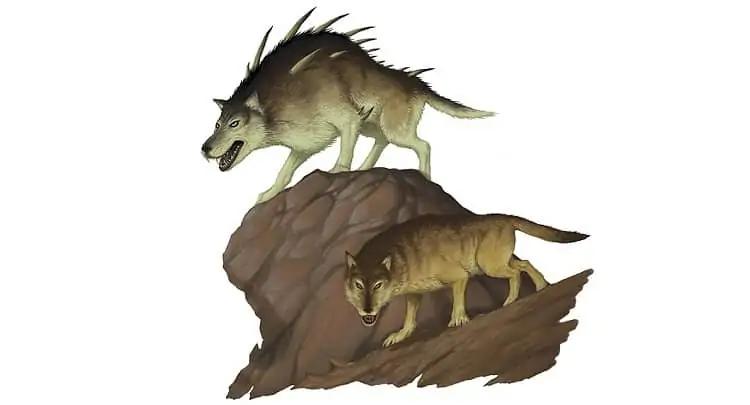
Some wolves with dire reputations are perfect to make fighting more thrilling if your group is often in the woods.
There is a possibility that they will hear about the huge dire wolf, with more stats than the traditional dire wolves. They also have a pelt which is impervious to magic. They are able to be teleported according to myths.
The rune-bound direwolves are another fantastic dire wolf that has runes that cover their bodies. They can draw on these runes to enhance their capabilities.
Other groups have signed agreements with werewolves and other supernatural creatures to seek their aid and inspire their followers with a roar filled with bloodlust and terror.
See also: Phantasmal Force 5e D&D Guide : Everything You Need To Know
The never-ending trek through the woods could be enhanced by fighting a few wolves that could result in epic and unforgettable fights.
Do Enemies Use Dire Wolves?
Goblin tribes may have used regular wolves to carry their animals as well as orcs and bandits, reported to have utilized wolves to defend their people. But dire wolves may be hard to distinguish.
If you compare them to a vast variety of grey wolves in the globe dire wolves are uncommon. Their inherent aggression makes it difficult to teach them.
Perhaps an opponent Druid, sorcerer or a sorcerer is the rare Wolf for a pet, or even a ranger who keeps one as a pet.
They won’t be the norm it’s unlikely that you’ll see any wretched wolves along with the armies of the enemy marching through your towns and villages.
Dire Wolf 5e Guide: FAQs
Can a Dire Wolf be my Ally?
You’re able to choose from a wide range of options when you require familiars to help you during battles or in other circumstances. There are a variety of options available including bats, owls snakes, and mice.
It’s up to you if you would like to become an elk. While the dire wolf isn’t permitted to be classified as known in the rules of the game There are no restrictions on players being able to be a celestial Wolf if it is approved granted by the DM. Also Read: Ice Knife 5e D&D Guide
See also: Detect Thoughts 5e D&D Guide : Everything You Need To Know
Rangers could be accompanied by a dire wolf an animal partner. But the issue is that dire wolves are more sophisticated than a regular Wolf. The ranger has an advantage when your dire Wolf is utilized for a specific use.
It could not be an game-breaker in the event that the DM and the player are aware and the player doesn’t benefit from the boost in intelligence. It’s not permitted in the rules of play.
Druids might wonder what they could do to transform into a wolf-like creature in order to take on wild appearance. They could. It is possible to do this at levels 1-5 thanks to the low chance of regaining the CR for the direwolf. If your DM is prepared and willing to make homebrew it, this is the only option to have an ally of the dire wolf.
Can Dire Wolves Make use of their claws?
The most powerful weapon of the wolf of the abyss is its jaw. Other four-legged creatures are equipped with claws. You can also include a claw attack on dire wolves, making them more danger than other animals.
See also: Circle of the Shepherd D&D Guide : Everything You Need To Know
To counterbalance the additional attack less effective that the attack to bite and then condition it.
Wolfes are known to bite their prey, and then take them to the ground. They make use of their claws for draw them in and then run. Prey are held in place by their claws instead of being attacked. Perhaps the wolf tries to bite its prey using some attack. Then , they will utilize the claws of their prey to wrestle with the prey.
Prey should ensure that they don’t attempt to escape from the cage only to fight the predator by claws. This is more realistic than what happens in the real world.
If you’d rather to play fantasies video games rather than reality, then you can make the Wolf the ability to attack with very weak claws.
Do Dire Wolves Fight to the Death?
Regular wolves leave when the pack is injured and their target is harder than they imagine. What is the situation with dire wolves who are aggressive?
They are determined and obsessed with killing and fighting and battle, which is an DM choice. They may become obsessed with killing to keep their survival nature. It is possible to make them run away to 1/3 their hitpoints in order to demonstrate their strength.
See also: Find Familiar 5e D&D Guide : Everything You Need To Know
They’ll be a formidable opponent that you and your group won’t forget! Navigation after navigation.