When fans debate nagi vs isagi who would win in Blue Lock, the clear winner in a full match or sustained competition is Yoichi Isagi. While Seishiro Nagi possesses superior natural ball control and explosive trapping genius, Isagi’s Metavision, tactical adaptability, and relentless ego allow him to outread and outlast Nagi when the stakes are highest. Nagi can win isolated 1v1 moments with impossible touches, but Isagi controls the pitch and consistently turns those moments into victories.
Fighter Profiles: Yoichi Isagi vs Seishiro Nagi
Yoichi Isagi
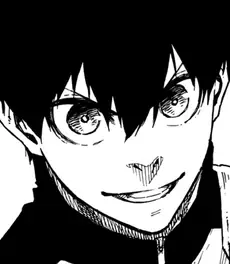
Yoichi Isagi enters the Blue Lock project as a 16-year-old second-year high school forward from Saitama who played for Ichinan High School, standing 175 cm (5’9″) tall (turning 17 from Chapter 209 onward). Unlike fellow competitors scouted by Anri Teieri, Isagi was personally chosen by Jinpachi Ego himself after Ego watched him play. Initially ranked 299th upon entering Blue Lock and placed in Team Z during the First Selection wearing #11, Isagi lacks elite physical speed, dribbling flair, or raw power. Instead, his foundation is spatial awareness, a cognitive ability that lets him process the field as a whole along with the positions, weapons, and movements of the players on it. Over the course of the manga, he pairs this vision with his signature Direct Shot, a one-touch volley fired without trapping or adjusting the ball first, allowing him to score before defenders can close the angle.
During the Neo Egoist League (NEL), Isagi starts as #11 for Germany’s Bastard München and evolves his spatial awareness into Metavision (awakened in Chapter 182 against Manshine City). By constantly scanning his surroundings with peripheral vision, he predicts plays ahead and manipulates teammates and rivals alike as “pieces” to be devoured or linked into chemical reactions. In Chapter 257 against Paris X Gen (P.X.G.), Isagi unveils the Two-Gun Volley, feinting with his left leg before striking with his dominant right foot in mid-air to beat both Rin Itoshi and Michael Kaiser. By the end of the NEL in Chapter 295, Isagi finishes tied with Rin Itoshi for Rank 1 in Blue Lock with a ¥240,000,000 bid from Bastard München, qualifying for the 23-man Japan U-20 squad. Starting for Japan U-20 as a forward or offensive midfielder, Isagi even earns the moniker “Otherworldly Cheater” from England’s coach, Fox, during the U-20 World Cup group stage after creating an original role by playing as a defender, midfielder, and forward simultaneously.
Isagi’s primary weakness is his unremarkable physical baseline as a self-described “talented learner” rather than a natural physical genius like Julian Loki or Rin Itoshi. As a Raumdeuter—a space investigator—he is a limited dribbler who is not characterized by pace, meaning he cannot rely on raw speed or strength in isolated 1v1 duels. Although his body grows noticeably more muscular and sturdy by the time of the U-20 World Cup, he still depends on off-the-ball movements, reflex, and teammates who can deliver usable balls into dangerous spaces. However, his clinical obsession with self-destruction and reconstruction has repeatedly turned his physical limitations into a non-factor.
Seishiro Nagi

Seishiro Nagi is a natural football prodigy from Hakuho High School—and the titular protagonist of the spin-off Blue Lock – Episode Nagi—who only began playing the sport six months before entering Blue Lock, recruited and managed by his classmate Reo Mikage. Standing 190 cm (6’3″) tall and aged 17 at the start of the series (turning 18 from Chapter 302 onward), Nagi initially ranks 221st in the main manga (251st in Episode Nagi) yet quickly establishes himself as Team V’s #11 ace and the best player in his First Selection stratum. Later starting at right wing for England’s Manshine City in the Neo Egoist League, Nagi is defined by his supernatural first touch and world-class trapping: he can kill the momentum of any pass using his feet, chest, heels, or even his back, turning awkward balls into immediate scoring threats.
Nagi’s peak feat arrives during the Bastard München vs. Manshine City match (Chapters 174–202), where he reunites with Reo and scores the Five-Shot Revolver Fake Volley (also referred to as a five-stage volley) in Chapter 190 over both Isagi and Michael Kaiser. By chaining four progressive mid-air feints and traps before unleashing the fifth strike, Nagi produces a goal born from Flow state that defies conventional defensive logic. Earlier in the series, he also demonstrates elite aerial reach, flexible body control, and acrobatic finishing during the First Selection against Team Z (Chapters 26–37, Episodes 9–11) and the Blue Lock Eleven match against Japan’s U-20 team.
Despite his generational talent, Nagi’s fatal weakness is his fragile, externally driven ego. Because he originally viewed soccer as a tedious chore and found his competitive fire primarily through his fixation on beating Isagi, his motivation collapses once he feels satisfied. After scoring his miracle goal against Isagi and climbing to Rank 2 in Chapter 204, Nagi’s lack of a foundational soccer education leaves his unpolished playstyle predictable as opponents shut him down. His ranking drops to 7th in Chapter 240, 11th in Chapter 246, and finally 24th in Chapter 298 with a ¥24,000,000 bid, missing the top 23 cutoff for Japan’s U-20 World Cup squad. Although Nagi initially declines Hirotoshi Buratsuta’s “Side-B” offer after being locked off, deep frustration over his mundane high school routine drives him to break into a U-20 World Cup VIP box and forcefully demand a spot in Side-B, tackling the “Bird Cage” and “Taboo Game” with a newly forged, independent drive to become the world’s best striker at any cost.
Ball Control and First Touch: Nagi Wins
There is no contest when it comes to pure ball control. Seishiro Nagi possesses arguably the most extraordinary first touch and trapping ability in Blue Lock, allowing him to score some of the most outrageous goals in the entire program. Even before entering Blue Lock, Nagi demonstrated his innate gift by trapping a falling cellphone in mid-air while jumping down a flight of stairs—the exact feat that convinced Reo Mikage to make him his football partner. On the pitch, whether a pass arrives awkwardly, with heavy spin, or at chest height, Nagi absorbs its velocity instantly with his toes, heels, chest, or back and transitions directly into a shot or feint.
Isagi, by contrast, is a Raumdeuter whose first touch is efficient for set-up plays, yet his limited dribbling prevents him from holding off elite defenders inside the penalty box. His signature Direct Shot exists specifically so he can strike in one motion without giving defenders a second-touch window to recover. If Isagi stops to control the ball against faster or stronger markers like Michael Kaiser, Rin Itoshi, or Oliver Aiku, they will close him down and block the lane. Isagi compensates with off-the-ball movement and instant volleys, which is brilliant tactically, but it addresses a technical limitation that Nagi simply does not share.
In any scenario where both players receive a difficult, contested pass in tight traffic, Nagi is far more likely to control it cleanly and create something out of nothing. His toolkit includes the Black Hole Trap to kill a ball dead in mid-air, the Creative Trap to flick a pass over a trailing defender’s shoulder, the Trap Shot, and the Zero Reset Turn to hold off multiple markers while trapping and bursting past them. Even when defenders read his initial movement, his Five-Shot Revolver Fake Volley against Bastard München proved he can rewrite a play in mid-air. Nagi takes this category decisively.
The contrast is clearest when both players handle a demanding service under immediate defensive pressure. After training under Chris Prince at Manshine City, Nagi refined the fundamentals of his ball control, enabling him to trap high-power close passes at great speed and control the ball even while two defenders press him simultaneously. He also weaponizes his first touch as a playmaker through his First Touch Pass, famously using a heel flick to lob Isagi’s difficult pass over the Japan U-20 defense back to a charging Isagi. Isagi’s first touch serves his positioning cleanly, whereas Nagi’s first touch is a standalone offensive weapon capable of beating defenders before he even takes a stride.
Spatial Awareness and Vision: Isagi Wins
Nagi possesses good instinctive spatial awareness around the penalty box, using it alongside his trapping to place himself at optimal spots for follow-up shots and creative flicks. After training with Manshine City, he also began taking greater initiative to create his own plays rather than merely acting as a piece in someone else’s system. Even so, his field vision remains narrower and more localized than Isagi’s, focusing largely on the pocket of space immediately around the ball and nearby defenders.
Yoichi Isagi operates on a completely different plane. From the First Selection onward, Isagi’s spatial awareness is his defining weapon, and by the Neo Egoist League it evolves into full Metavision. Isagi constantly scans the field to gather peripheral data, building a comprehensive mental model of every player’s position, movement, and weapons. He does not merely react to where the ball is; he makes accurate predictions about the flow of the game and arrives at the decisive blind spot before anyone else recognizes the opening.
Moreover, Isagi pairs Metavision with Egocentrism, meaning he tracks the underlying desires and “protagonist” impulses of everyone on the field. He reads when a defender will overcommit, when a rival will refuse to cooperate, and how teammates can be pushed into triggering chemical reactions. In a head-to-head match, Isagi’s vision allows him to anticipate and cut off Nagi’s supply lines before the ball ever reaches Nagi’s feet. Isagi wins this category by a wide margin.
This gap was laid bare during the Bastard München vs. Manshine City match. While Nagi channeled his focus into conquering Isagi and Kaiser in his immediate vicinity, Isagi was mapping the movement of the entire pitch, coordinating rapid passing links with Ranze Kurona and reading Reo’s intended passing lanes to Nagi. Even after Nagi stunned the pitch with his Five-Shot Revolver Fake Volley, Isagi used Metavision to shut down Manshine City’s final attacks and orchestrate the match-winning counter. Nagi has lethal instincts near the goal, but Isagi oversees the whole chessboard.
Scoring Consistency and Finishing: Isagi Wins
At his absolute ceiling, Nagi’s finishing is flashier and more unpredictable than Isagi’s. A player capable of executing a Five-Shot Revolver Fake Volley past both Isagi and Michael Kaiser—and pulling off acrobatic finishes like the Hand Spin Breakdance Shot—can score goals that no standard defensive scheme can easily replicate. In the First Selection, Nagi was Team V’s primary scoring engine, racking up goals effortlessly through sheer natural talent.
However, scoring consistency over a sustained tournament is where Nagi falters. Once his hunger faded after beating Isagi in a 1-on-1 during the Bastard München match, Nagi’s lack of foundational soccer knowledge left him predictable. As opponents in the Neo Egoist League learned to shut down his unpolished playstyle, his production dried up and his valuation steadily slid from Rank 2 in Chapter 204 to Rank 7 in Chapter 240, Rank 11 in Chapter 246, and finally Rank 24 in Chapter 298.
Isagi’s Direct Shot and Two-Gun Volley are engineered for repeatability. Because Isagi manufactures high-percentage chances through off-the-ball runs, reflex, and Metavision, his goals rarely depend on low-percentage miracles. Even when elite rivals bracket him from both sides—as Rin Itoshi and Michael Kaiser did against Paris X Gen in Chapter 257—Isagi adapts his mechanics in mid-air to create a reliable finishing angle. He finished the Neo Egoist League tied with Rin for Rank 1 at ¥240,000,000 because he delivers goals and decisive plays consistently against top U-20 club squads. Isagi takes scoring consistency.
Consistency in football is not about who produces the flashiest single highlight; it is about who can be trusted to deliver late in a tight match when opponents know his primary weapon. During the Bastard München vs. Ubers match, Isagi unveiled a left-footed Direct Shot—developed through secret training with Rensuke Kunigami—to score even when Alexis Ness physically collided with him to block his dominant right foot. Combining both feet into the Two-Gun Volley against P.X.G. turned his finishing into a two-option threat that defenders could no longer predict. Nagi’s scoring threat, until his Side-B reinvention, proved far more vulnerable once defenses denied him comfortable trapping zones.
Physicality and Athleticism: Nagi Wins
Nagi’s physical frame gives him a clear edge in direct athletic duels. At 190 cm (6’3″) compared to Isagi’s 175 cm (5’9″), Nagi possesses a lean yet muscular build, long limbs, and exceptional mid-air flexibility. Even though Nagi is famously lethargic off the pitch, his natural athleticism allows him to contort his body in mid-air—seen in moves like his Hand Spin Breakdance Shot and Sky High Air Flare Pass, where he plants a hand on the ground or an opponent’s back to spin and create momentum. Furthermore, after physical analysis and conditioning with Manshine City under Chris Prince, Nagi became noticeably stronger physically.
Isagi has worked diligently to improve his physique since entering Blue Lock, developing a more defined, muscular, and sturdy build by the time of the U-20 World Cup. He has the stamina and core balance to sustain high-intensity Metavision across a full match and execute aerial feats like the Two-Gun Volley under contact. Still, he lacks god-given physical traits like Julian Loki’s superhuman speed, and as a Raumdeuter he is not built to outpace speedsters like Hyoma Chigiri or overpower physical forwards in shoulder-to-shoulder duels.
In a pure physical matchup—aerial reach, body control under contact, and shielding the ball—Nagi’s height, flexibility, and refined strength give him the clear advantage. Nagi wins this category.
This athletic edge shows clearly on lofted passes and contested balls inside the penalty area. Because Nagi can absorb contact while shielding multiple defenders in his Zero Reset Turn, or twist his torso mid-air to trap a high ball on his chest or thigh, he creates shooting windows that shorter forwards cannot access. Isagi has to rely on timing his off-the-ball runs into blind spots so he avoids prolonged physical grappling altogether.
Playmaking and Tactical IQ: Isagi Wins
Unlike pure poachers who never pass, Nagi does possess legitimate creative playmaking tools—fitting his Creative Midfielder archetype alongside his forward role. He can link quick one-two passes with partners like Reo Mikage or Isagi, and his First Touch Pass lets him redirect awkward balls into dangerous zones with his chest or heel, as he did to assist Isagi against the Japan U-20 team. After Manshine City’s training, he also worked to take more initiative in generating his own plays. Nevertheless, Nagi rarely dictates a team’s overall tempo, organizes a defensive press, or restructures the entire pitch’s spacing.
Isagi functions as an on-field tactical commander and striker combined. Through Metavision, he reads defensive shapes, identifies structural weak points, and drives teammates—including Yo Hiori, Ranze Kurona, and Jingo Raichi—up to his demanding technical standards to spark chemical reactions. Against Manshine City, he sliced through the midfield alongside Kurona, and against P.X.G., he manipulated the pitch to outmaneuver both Rin Itoshi and Michael Kaiser. Widely recognized by Sae Itoshi as the “heart of Blue Lock,” Isagi even invented an original position during the U-20 World Cup against England by playing as a defender, midfielder, and forward simultaneously.
If you place both players on separate teams of equal talent, Isagi’s side will operate as a cohesive, constantly adapting system, whereas Nagi’s side will still need structural guidance to unlock his finishing. Isagi wins playmaking and tactical IQ effortlessly.
That tactical disparity also explains why their Neo Egoist League market values diverged so sharply. Club bidders in the NEL value players who raise the floor of an entire squad as well as score. Isagi proved he can operate seamlessly as both a forward and an offensive midfielder, linking up with Hiori, Kurona, or even reluctant rivals like Kaiser when victory demands it. Nagi, by contrast, struggled to sustain teamwide offensive control once his individual patterns grew predictable in the second half of the league.
Adaptability Under Pressure: Isagi Wins
Adaptability is the very core of Yoichi Isagi’s identity. Whenever he hits an impenetrable wall—whether against Team V’s talent in the First Selection, Rin’s control in the Second Selection, or Kaiser and Loki’s brilliance in the Neo Egoist League—Isagi tears down his existing logic and rebuilds himself mid-match. He willingly abandons comfort, incorporates variables like luck or spatial errors, and “devours” rivals’ strengths to mutant-evolve on the fly.
Nagi’s reaction under peak Neo Egoist League pressure revealed the opposite tendency. In Manshine City’s final NEL match against FC Barcha (Chapter 298), Nagi resolved to win without relying on Reo, intercepted a pass from Meguru Bachira, and combined with Chigiri and Agi to drive at goal. Yet the moment Eita Otoya and Barcha’s defenders anticipated and shut down his movement, Nagi hesitated and panicked, reverting to old habits by attempting a pass back to Reo. Bachira intercepted that pass and went on to seal FC Barcha’s 3-2 victory, directly resulting in Nagi’s elimination.
Under maximum pressure in the NEL, Isagi evolved while Nagi reverted. Isagi wins this category without question.
That contrast separates a reliable world-class competitor from a streaky prodigy. When opponents solve Isagi’s current formula, he treats the failure as data and immediately constructs a new logic on top of it—a resilience rooted in having no external baggage, only an obsession with winning and self-reconstruction. When opponents took away Nagi’s comfortable trapping rhythms during his slump, his confidence wavered and his decision-making faltered, forcing him to rebuild his fundamentals from scratch inside Side-B’s “Taboo Game,” where his trademark trapping was outright prohibited.
Ego, Drive, and Mentality: Isagi Wins
Blue Lock revolves around the concept of ego, and Isagi embodies Jinpachi Ego’s philosophy more purely than anyone else. Starting the program timid and shackled by Japan’s traditional team-first high school football mindset, Isagi shed his passive facade the moment he tasted victory. His hunger is fueled by an untainted, relentless obsession with personal satisfaction, winning, and meeting a “new me” on the pitch. Scoring one great goal never satisfies him; pushed to the brink in the NEL and U-20 World Cup, he embraced his role as the “Demon King of Blue Lock,” locking into a lethal, freedom-type flow where winning at any cost is his only truth.
Nagi’s ego has historically been his Achilles’ heel. He entered football out of lethargy, playing first to support Reo’s dream and later finding motivation solely through his fixation on beating Isagi. Once Nagi conquered Isagi in that 1-on-1 during the Bastard München match, he felt a fatal sense of satisfaction. As Jinpachi Ego bluntly explained during Nagi’s elimination in Chapters 299–300, Nagi’s talent withered not from lack of skill, but because a beast with a full stomach forgets how to hunt.
To his credit, Nagi refused to stay down permanently: after initially declining Hirotoshi Buratsuta’s offer and enduring the stagnation of regular high school life, he broke into a U-20 World Cup VIP box to demand entry into Side-B. Shedding his old codependencies with Reo and his lingering fixation on Isagi, Nagi declared his new ego in Chapter 312—”I wanna be the World’s Best”—vowing to succeed even if it meant destroying Blue Lock and his former teammates. Even so, Isagi’s mentality has already been proven at Rank 1 and on the U-20 World Cup stage. Isagi wins ego and mentality.
Isagi vs Nagi Scorecard
| Category | Yoichi Isagi | Seishiro Nagi | Winner |
|---|---|---|---|
| Ball Control & First Touch | Efficient Raumdeuter touch, but limited dribbler; relies on one-touch Direct Shots | Supernatural trapping; kills passes mid-air with Black Hole & Creative Traps | Seishiro Nagi |
| Spatial Awareness & Vision | Metavision & Egocentrism; maps the entire pitch and predicts plays | Good box awareness, but narrower overall field vision | Yoichi Isagi |
| Scoring Consistency | Repeatable Direct Shot & Two-Gun Volley; tied #1 NEL bid (¥240,000,000) | Explosive ceiling (Five-Shot Revolver), but slumped from #2 to #24 | Yoichi Isagi |
| Physicality & Athleticism | 175 cm; stronger build by U-20 WC, but lacks elite pace | 190 cm frame, long reach, elite aerial flexibility & refined strength | Seishiro Nagi |
| Playmaking & Tactical IQ | Orchestrates chemical reactions, team shape, and an original U-20 role | Creative First Touch Passes, but rarely dictates whole-team tempo | Yoichi Isagi |
| Adaptability Under Pressure | Tears down and reconstructs his playstyle mid-match to survive | Hesitated against FC Barcha and passed back to Reo under pressure | Yoichi Isagi |
| Ego, Drive & Mentality | Relentless, self-sustaining hunger to be #1 (“Demon King of Blue Lock”) | Lost fire after satisfying his Isagi fixation; now rebuilding in Side-B | Yoichi Isagi |
Final Score: Yoichi Isagi 5 — Seishiro Nagi 2.
What Happened When Isagi and Nagi Met in Blue Lock
The rivalry between Yoichi Isagi and Seishiro Nagi is one of the defining threads of Blue Lock, and their shared history tracks their diverging trajectories.
Their first clash took place in the First Selection during the do-or-die match between Team Z and Team V (Chapters 26–37, Episodes 9–11). Team V dominated early behind Nagi’s effortless trapping and Reo’s playmaking, but Isagi unlocked his Direct Shot and led a shorthanded Team Z—playing down to ten men after Wataru Kuon’s betrayal and eventual red card—to a dramatic 5-4 comeback victory. That defeat was the first time Nagi felt genuine frustration, sparking his curiosity about football and his fierce desire to challenge and surpass Isagi.
In the Second Selection, Nagi chose to leave Reo and team up with Isagi and Meguru Bachira on Team White. Even after Bachira was taken following a narrow loss to Rin Itoshi’s squad, Isagi and Nagi continued together, adding Shoei Barou and later Hyoma Chigiri on Team Red before both eventually cleared the Second Selection and went on to start alongside each other for Blue Lock Eleven against the Japan U-20 team. Playing with Isagi highlighted Nagi’s lethal finishing—and Nagi even assisted Isagi with a heel flick over the U-20 defense—while also shielding Nagi from having to carry full tactical responsibility alone.
Their true collision as Neo Egoist League rivals came during Bastard München vs. Manshine City (Chapters 174–202). Nagi reunited with Reo specifically to defeat Isagi, culminating in his iconic Five-Shot Revolver Fake Volley over Isagi and Kaiser in Chapter 190. Yet even in that match, Isagi awakened Metavision, shut down Manshine City’s late attacks, and delivered a decisive backheel assist to Kenyu Yukimiya in Chapter 202 for a 3-2 Bastard München victory.
From that point on, their trajectories split completely. Isagi kept evolving, adding a left-footed Direct Shot against Ubers, unveiling the Two-Gun Volley against P.X.G. (Chapter 257), and finishing the NEL tied with Rin Itoshi for Rank 1 at ¥240,000,000 (Chapter 295). Meanwhile, Nagi’s motivation collapsed after satisfying his fixation on beating Isagi. Unable to adapt independently when defenses solved his patterns, he slid to 24th place at ¥24,000,000 in Chapter 298 and was locked off from Japan’s U-20 World Cup squad, leaving Isagi as the clear winner of their NEL rivalry.
Even in the aftermath of his elimination, Nagi’s arc underscores how decisively Isagi pulled ahead. After initially rejecting JFU Chairman Hirotoshi Buratsuta’s Side-B offer, Nagi realized his old mindset was dead and forced his way into Side-B to rebuild his ego from scratch under the harsh rules of the “Bird Cage” and “Taboo Game.” Isagi, meanwhile, had already claimed the #11 starter role for Japan’s U-20 World Cup team and continued evolving against international competition.
Related Guides
Frequently Asked Questions
Isagi vs Nagi: Who is stronger right now?
Yoichi Isagi is significantly stronger than Seishiro Nagi. Isagi finished the Neo Egoist League tied with Rin Itoshi for Rank 1 with a ¥240,000,000 bid, starts for Japan’s U-20 World Cup squad with Metavision and the Two-Gun Volley, and was even dubbed an “Otherworldly Cheater” by England’s coach Fox after inventing an all-around role on the pitch. Nagi, by contrast, slumped to 24th place in the NEL and is fighting to rebuild himself in Side-B.
Was Nagi eliminated from Blue Lock?
Yes, Seishiro Nagi was locked off from the main Blue Lock project in Chapter 298. After hesitating against FC Barcha’s defense and having his pass back to Reo intercepted by Meguru Bachira in a 3-2 loss, he finished 24th in the final Neo Egoist League rankings with a ¥24,000,000 bid—one spot outside the top 23 cutoff for Japan’s U-20 World Cup squad.
How does Isagi beat Nagi in the Neo Egoist League?
Isagi beats Nagi in the Bastard München vs. Manshine City match (Chapters 174–202) by awakening Metavision. Even after Nagi scores his Five-Shot Revolver Fake Volley in Chapter 190, Isagi reads the entire pitch, neutralizes Manshine City’s final attacks, and delivers a backheel assist to Kenyu Yukimiya in Chapter 202 for a 3-2 victory.
Could Nagi return to Blue Lock?
Yes, Nagi’s story did not end with his Chapter 298 elimination. Although he initially turned down JFU Chairman Hirotoshi Buratsuta’s offer to join the “Side-B” shadow selection, Nagi later broke into a U-20 World Cup VIP box to demand a spot, entering Side-B with a new resolve to become the best striker in the world at any cost—even if it means destroying Blue Lock and his former teammates.
How does Isagi vs Bachira compare to Isagi vs Nagi?
Isagi vs. Bachira is a clash between two players who thrive on creativity and constant evolution, whereas Isagi vs. Nagi contrasts hard-earned tactical IQ with natural, effortless genius. While Meguru Bachira maintained his drive—finishing 5th overall in the Neo Egoist League with a ¥120,000,000 bid from FC Barcha and intercepting Nagi’s final pass in Chapter 298—Nagi’s lack of a self-sustaining ego caused him to fall behind.
What is the difference between Blue Lock and Ao Ashi?
Blue Lock focuses on hyper-individualistic strikers, exaggerated “ego” battles, and survival-game elimination rules, while Ao Ashi is a grounded tactical sports drama centered on youth academy development, fullback positioning, and team-first football. Both protagonists—Yoichi Isagi and Ashito Aoi—share elite spatial vision, but Blue Lock treats it as a weapon for scoring goals while Ao Ashi uses it to orchestrate the entire team’s defense and build-up.
Final Verdict
In a debate over nagi vs isagi who would win, Yoichi Isagi is the decisive winner. Seishiro Nagi has the prettier highlights and the most gifted first touch in Blue Lock, but football is not won on isolated tricks. Isagi’s Metavision, adaptability under pressure, and unbreakable ego allowed him to climb to Rank 1 and anchor Japan’s U-20 squad while Nagi’s complacency cost him his place in the main project. Even as Nagi reforges his mentality inside Side-B, he is chasing a completely different monster than the player he first faced in Team Z.